• About The Crew
  • Cooking Through ‘Modernist Cuisine’ At Home

Jet City Gastrophysics

~ Exploring Modernist Cuisine in the Northwest

Jet City Gastrophysics

Author Archives: jethro

Kitchen Cryogenics: Playing With Liquid Nitrogen

13 Thursday Jan 2011

Posted by jethro in blow shit up, liquid nitrogen

≈ 6 Comments

Tags

fudgesicle, ice cream, meringue, orange risotto, sorbet

LN2 Steam

Continuing my free fall into contemporary cooking techniques, I wanted to work with liquid nitrogen for some seriously cold cooking.  Liquid nitrogen is incredibly cold: −321 °F/−196 °C!  As it warms up, it boils away back into a gas, creating the exact opposite of a deep fryer – a deep freezer.  This is the stuff that urban legend says poor Walt Disney is frozen in for possible future reanimation.  My interests, however, are purely culinary.

Grabbing A Cold One

I wouldn’t be able to go to Sur la Table to get what I needed for this round of cooking.  I instead went to my local provider of industrial gases and inquired about purchasing a small amount of liquid nitrogen (also known as LN).  They said I couldn’t do it without the use of a dewar, a container especially designed for carrying and storing LN.  So, I did some research online, waited patiently, and was able to score a small 5 liter dewar for 40% off list price on eBay.
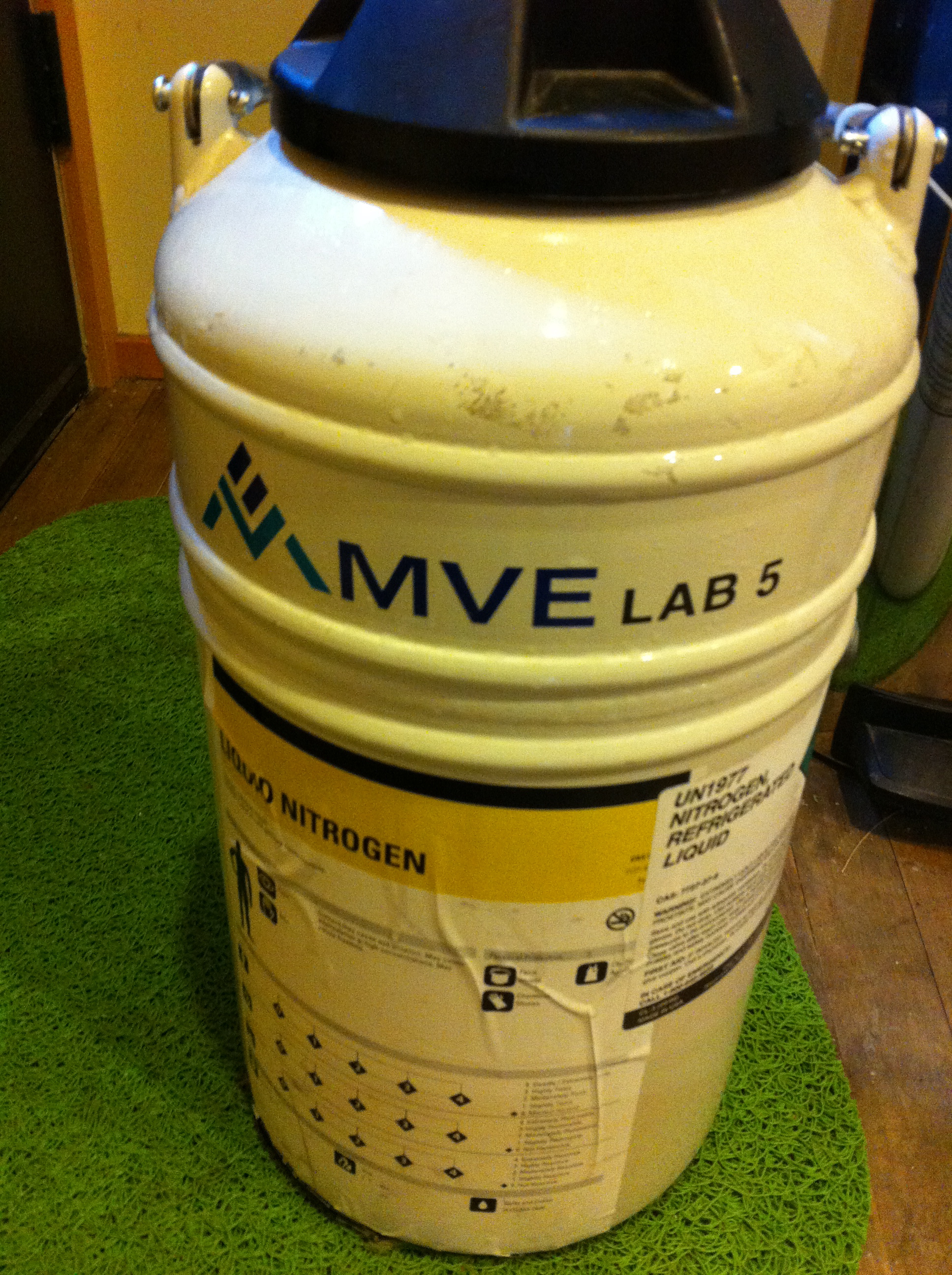
MVE Lab 5 Dewar

I first read Cooking Issues’ excellent Liquid Nitrogen Primer before I got started.  The three main takeaways:

  1. Do not keep LN under pressure in a closed container. It will explode. It can blow your hands off.  Thus, a proper dewar is necessary.
  2. You can suffocate on nitrogen and die and you won’t even know it.  Your body won’t warn you ahead of time.  You must be in a well ventilated area.
  3. It is really, really cold.  Avoid getting burned the same way you’d avoid hot oil.

It was a cold wet day in Seattle when I went to fill my dewar up with LN, but I still drove home with the windows down, the dewar tightly strapped in the back seat surrounded by towels, determined to not get killed before I froze some foodstuffs at home for my amusement.  I made it back safely and got down to some cold cooking.

Deep Freeze Frying

I placed a towel on my kitchen counter and placed a metal bowl inside of a larger metal bowl on top.  This was in case the LN was so cold the first bowl cracked open.  At least I would have a chance to get the thing outside if need be.  The window above the counter was opened for ventilation.  I decided to do a bunch of different things, some successful, others less so.  But it gave me a good insight into what’s possible.

First off was ice cream.  I was trying to make some ice cream bowls as Ferran Adria’s video showed in his talk at Google. At elBulli, they freeze an ice cream base on the underside of a ladle and then slip it off, creating a beautiful ice cream bowl to be filled with other goodies.  I, however, couldn’t get the bowls off correctly from the ladle – they were frozen solid on there, and they would always chip and break.  As my LN quickly evaporated, I decided to forgo that experiment after several tries and keep trying other techniques.

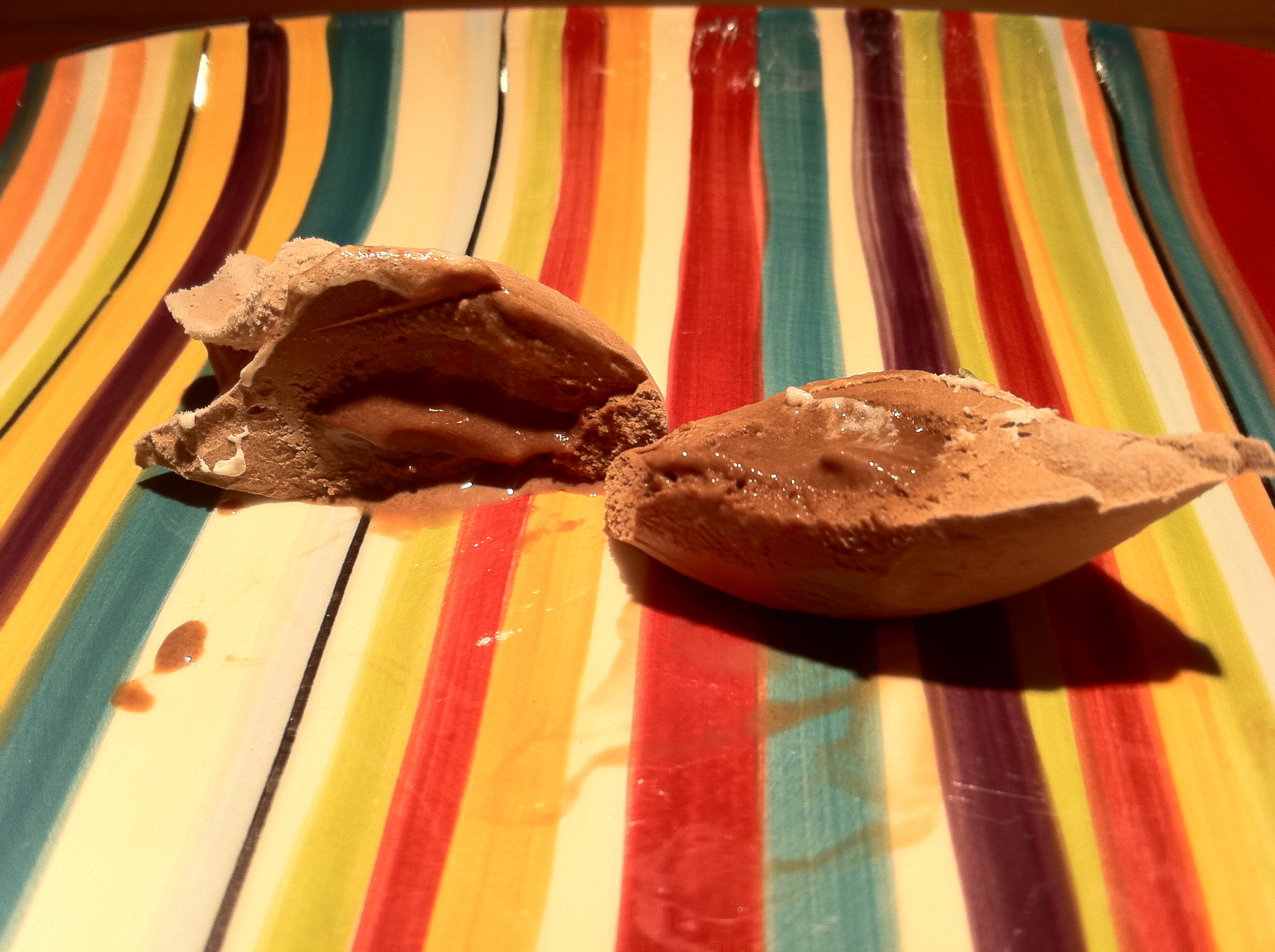
I scooped up some ice cream and threw it in.  It created a delicious little fudgesicle nugget, frozen on the outside but still creamy inside.
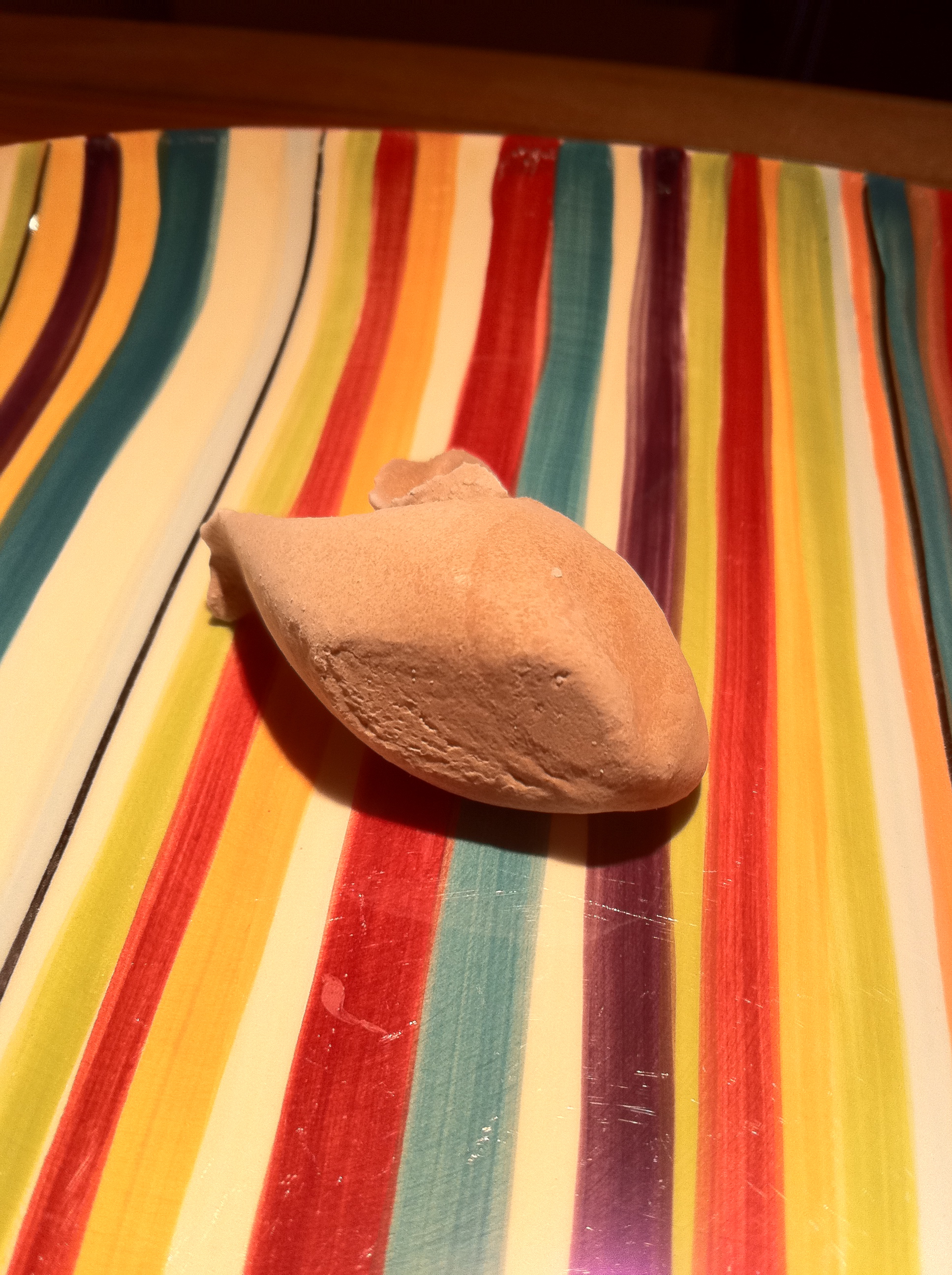
Fudgesicle Nugget
Creamy Chocolatey Goodness

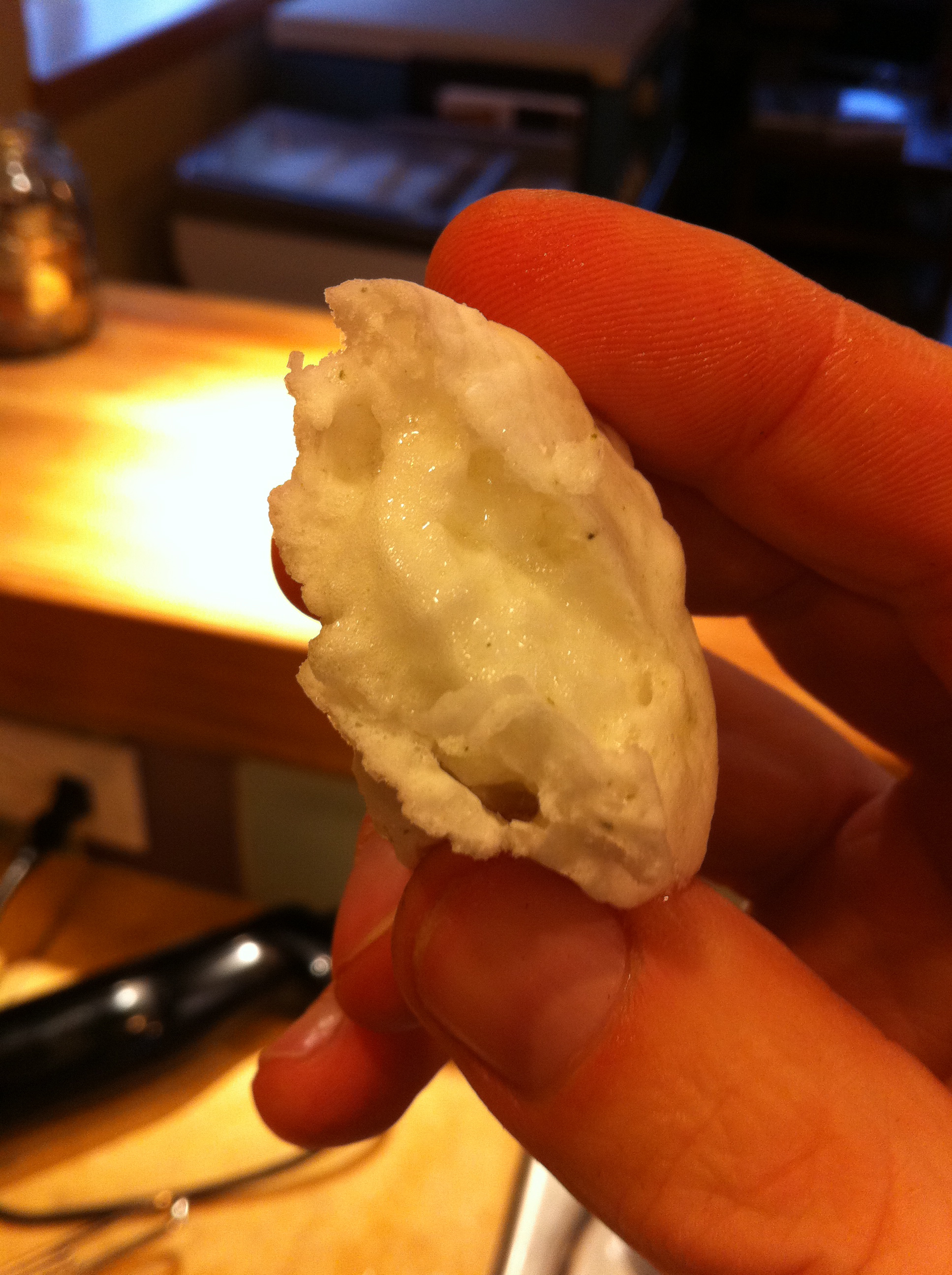
Next up was an idea for a frozen spruce meringue.  I beat some egg whites and sugar together until they were fluffy, and then added some spruce spice I made last week.  It turned out great  – cold, crunchy, and creamy.  And forest-y.
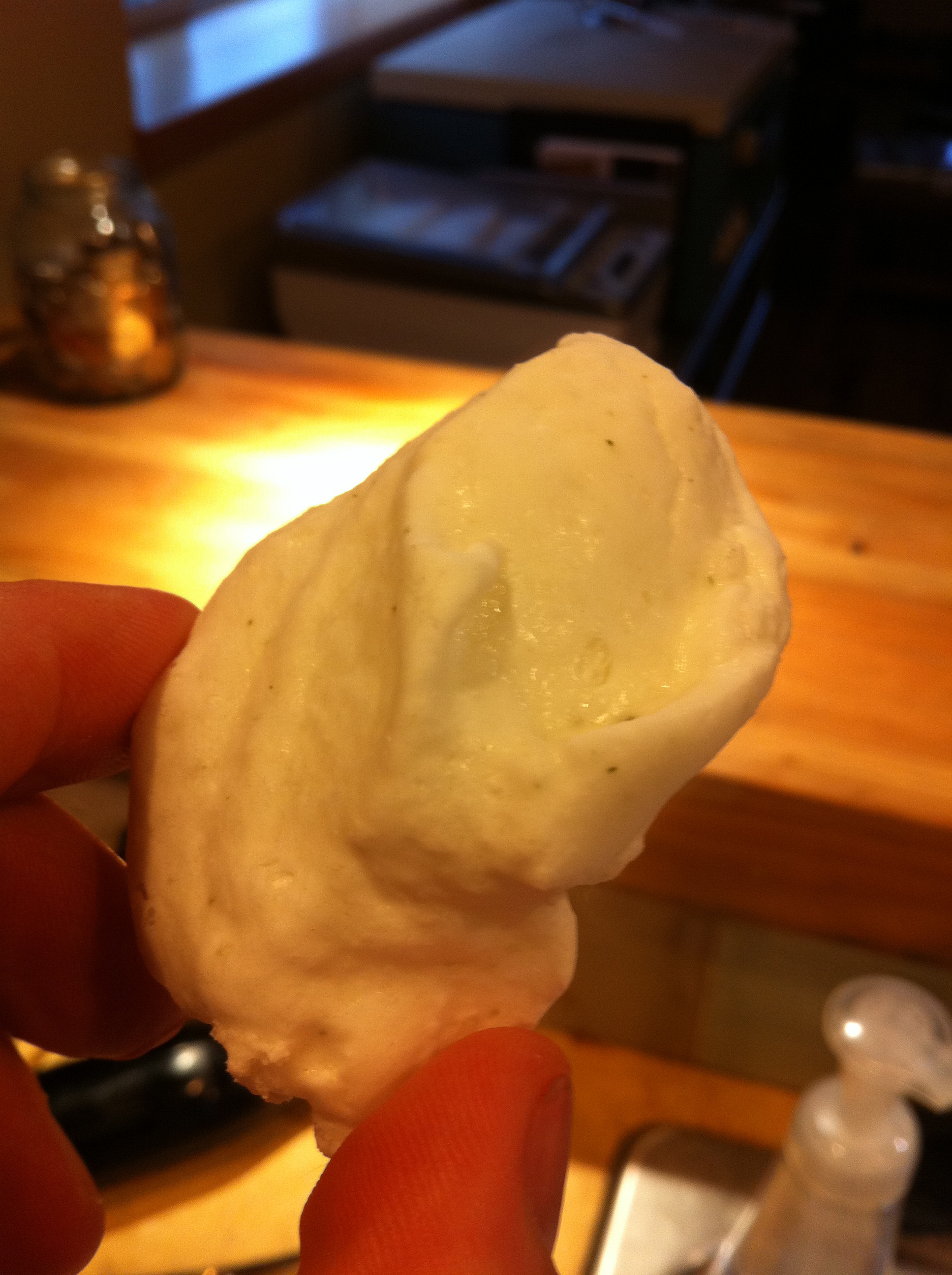
Frozen Spruce Meringue
Creamy Frozen Spruce Meringue

Next up – orange slices.  After a quick freeze, I smashed them in a bowl to create an orange risotto.
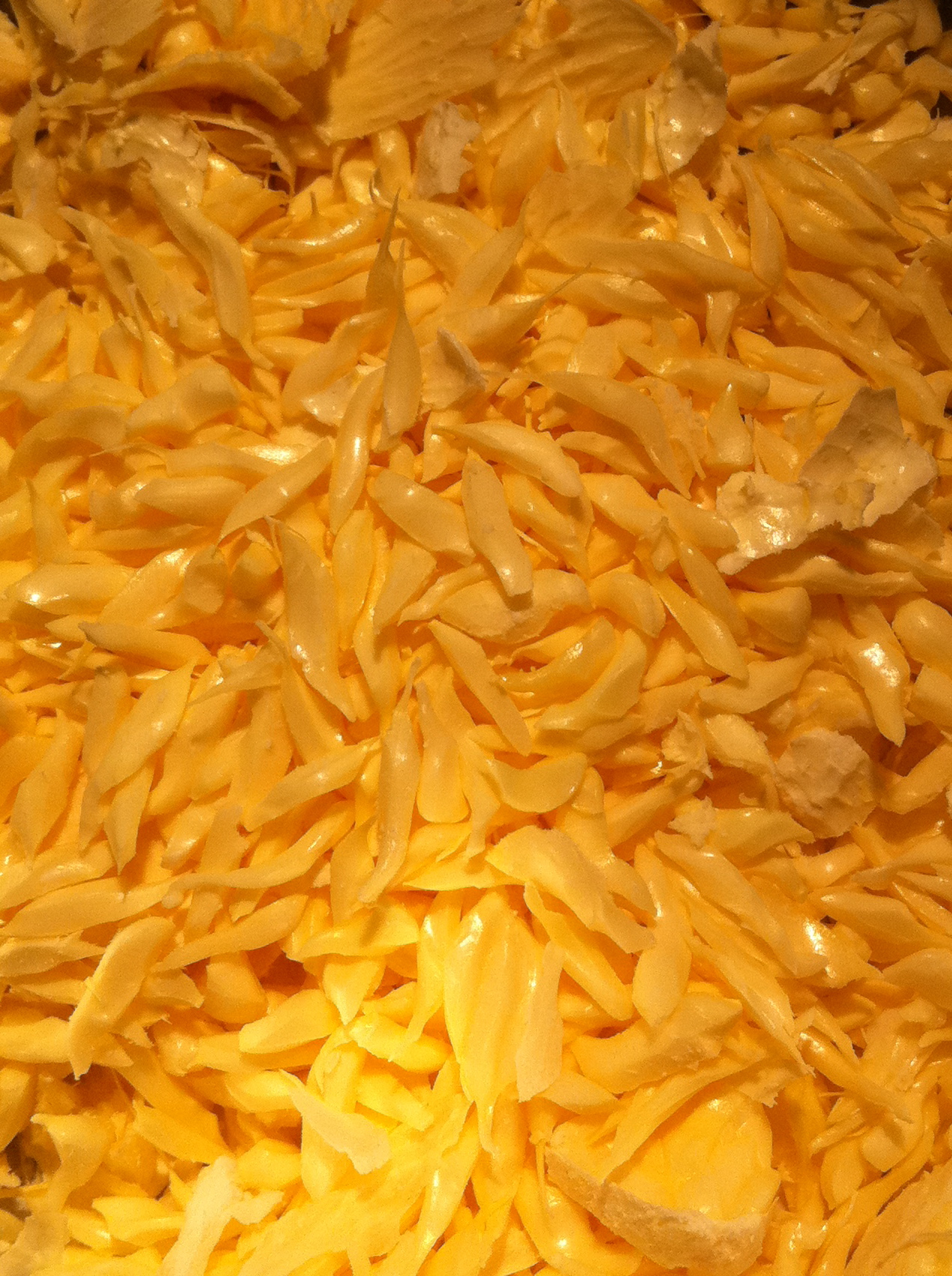
Orange Risotto

Finally, I messed with some alcohol.  Alcohol doesn’t freeze in the freezer, but LN has no problem with it.  I took plum wine and poured it into a small bowl.  I then stirred in LN to create an Asian alcohol sorbet.

Stir It Up

Plum Wine Sorbet

For the most part, my initial foray into the world of liquid nitrogen cooking was very successful.  And addictive.  With instant fudgesicles, ice creams and sorbets, I can see it being a big hit during summer BBQs.   I know now someday when I get a new home, my kitchen will have a hot station, a cold station, and a very, very cold station.
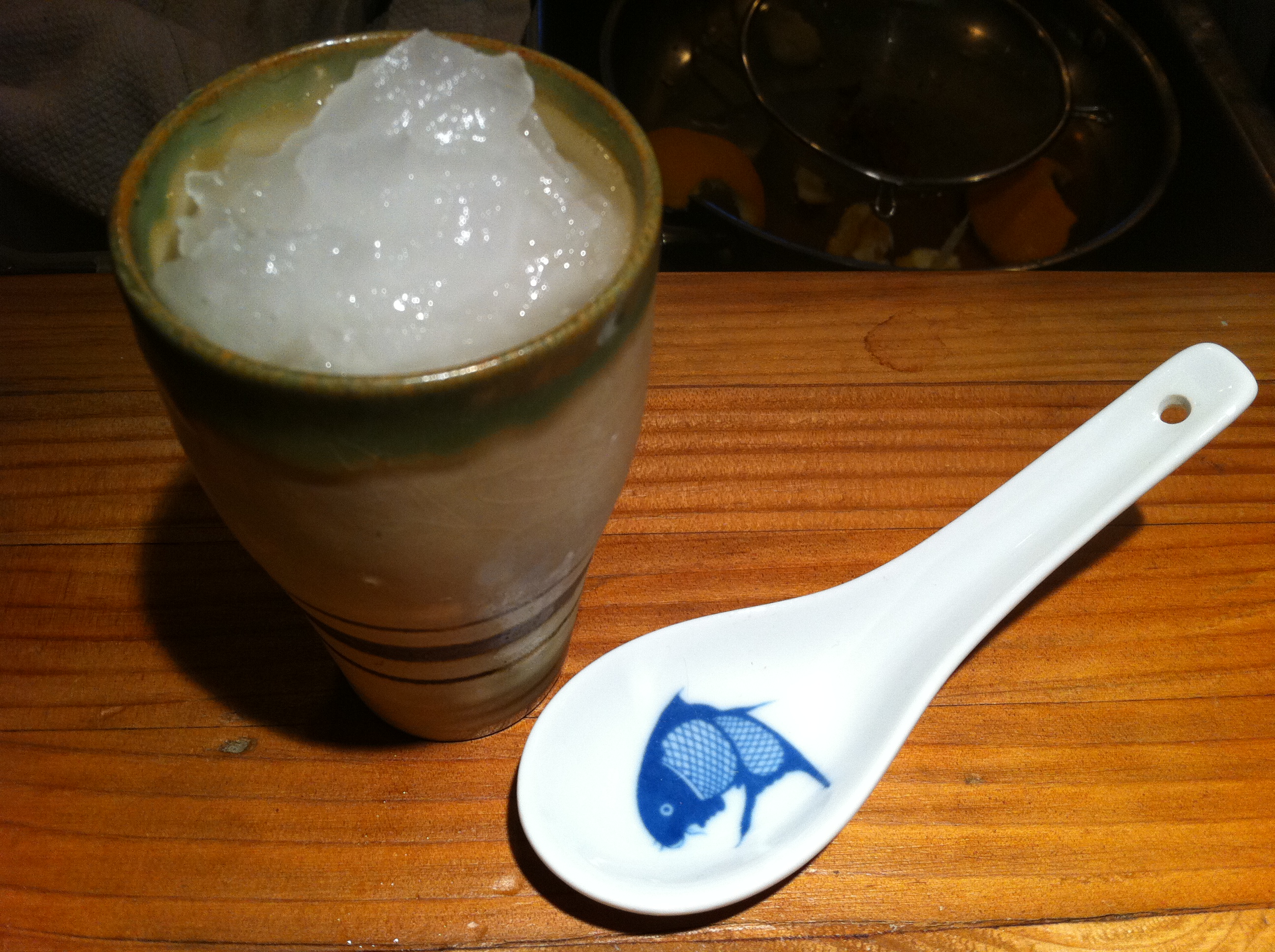
Sake Sorbet

Sake Sorbet

Jethro

Noma At Home: Spruce Oil, Butter, Vinegar and Spice

07 Friday Jan 2011

Posted by jethro in recipes

≈ 3 Comments

Tags

Noma, René Redzepi, spruce butter, spruce oil, spruce spice, spruce vinegar

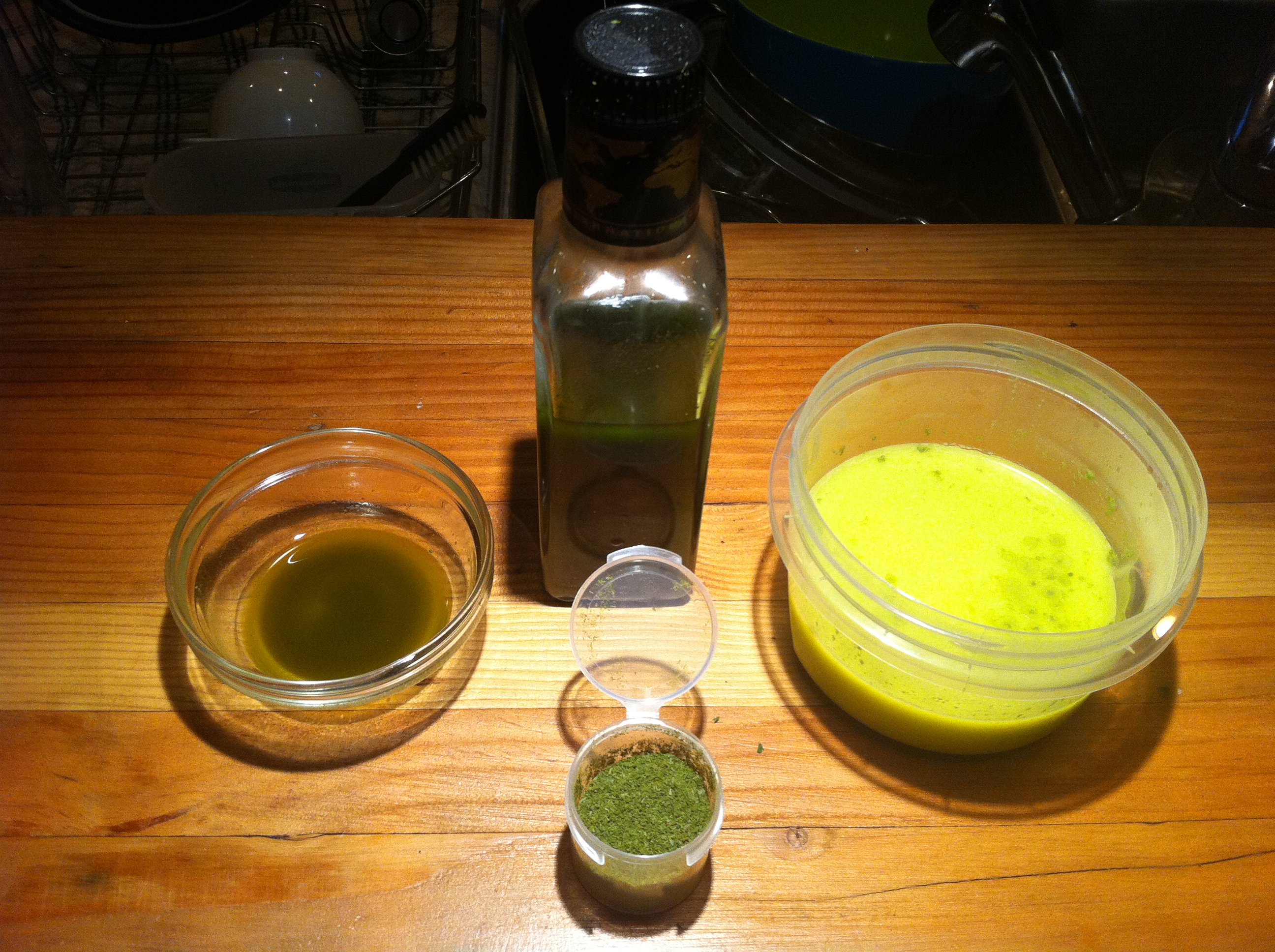
Spruce Ingredients

Clockwise From Top: Spruce Oil, Spruce Butter, Spruce Spice, Spruce Vinegar

Each year more than 100 million trees are produced for Christmas worldwide. Considering that it takes 8 to 12 years to produce a decent-sized tree, it seems pointless simply to discard this bounty after only a few weeks of using it as ornamentation. I don’t mean to sermonize. I want only to point out that food is everywhere, that a tree is more than a symbol or a decoration: it is delicious food.

This year, let’s all butcher the tree.
– René Redzepi

So evangelized Chef René Redzepi in his Christmas Eve Op-Ed piece in the New York Times, giving recipes and ideas on how to use spruce as food.  Now, I realize he wrote that he didn’t mean to sermonize, but with that last sentence, it is reasonable to say that he wanted to make converts, therefore I think to say he is evangelizing is perfectly legitimate.  Just to be clear. Anyway, at least he made one convert.  Me.

I have never had any spruce-scented dishes, and with all the verdant and lush greenery that surrounds us here, I thought it would be a perfect tool to use in creating a dish that evoked the Great Northwest.  But I don’t ‘do’ Christmas.  I didn’t have a tree standing in my living room, ready to be fleeced of its needles for sustenance.  Like the chanterelle mushrooms last autumn, I’d have to go foraging for one.

On The Public Denuding Of A Discarded Christmas Tree For Food

It was a few days after New Year’s, and I was strolling down the street toward my local coffee shop when it appeared before me, discarded and forgotten. My newest food source.

Urban Food Foraging

Should I Strip This Bare Of Needles In Public? I Should.

I went back home, grabbed a plastic bag, returned and began to pull needles by the handful into the bag.  In broad daylight. Next to a high school.  And a Boy Scouts office.  Kids walked past with their backpacks.  Cars pulled out of the Boy Scouts parking lot and drove past.  I was very aware of how strange I must have looked denuding a discarded tree on the side of the road, but thought I would be totally ignored for that very reason.  I was correct.  Soon, though, my discomfort got the best of me and I felt I had gotten enough. Yet, I returned after dark to get some more. Foolhardy? Completely ridiculous? Perhaps. But I had to keep in the spirit of the opinion piece.  Waste not, want not!

SprucE Butter

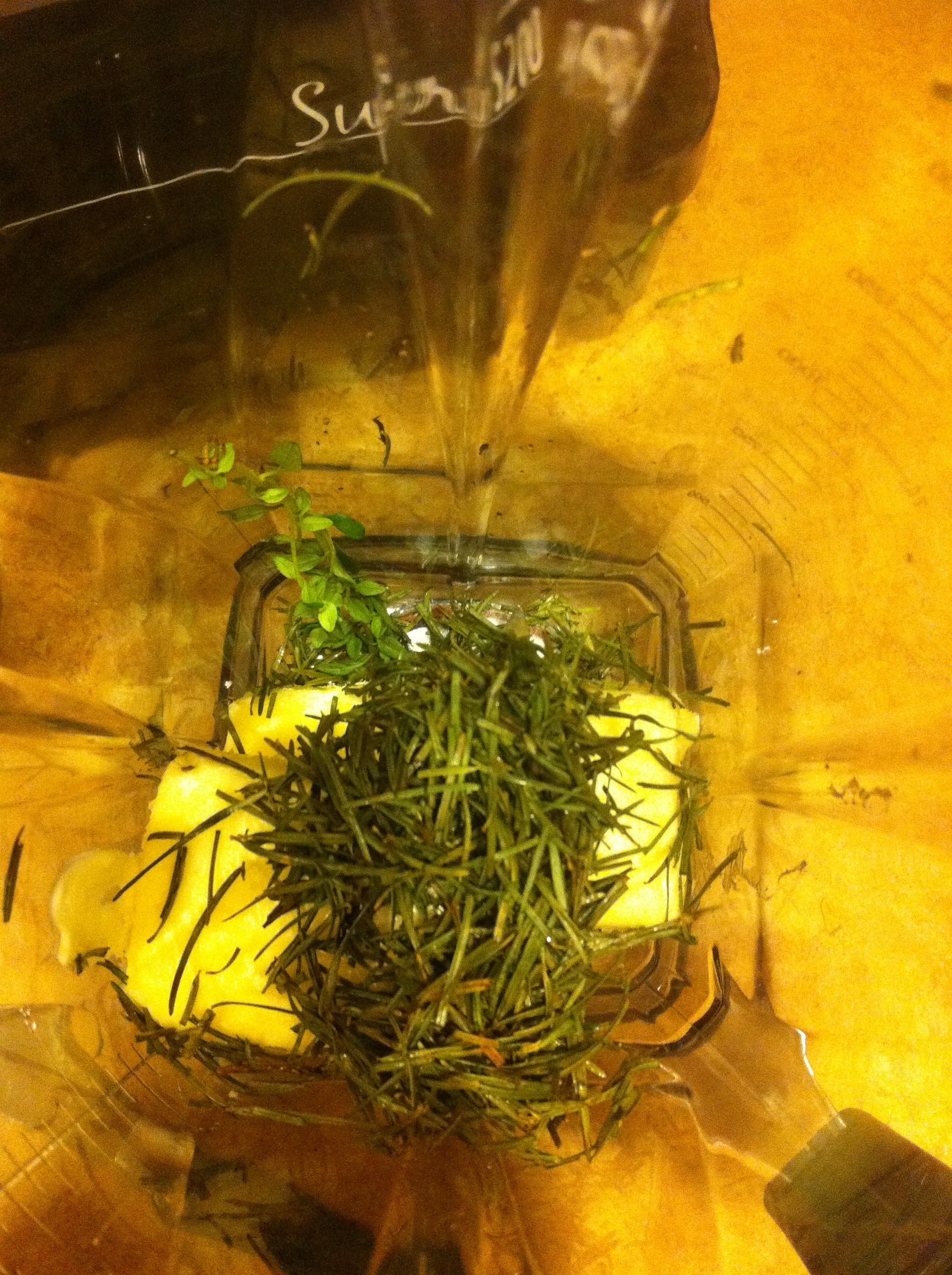
With my new batch of needles, I went to work.  I washed them and threw a few tablespoons in with some butter and lemon thyme into my VitaMix and let her rip.

Making Spruce Butter

I strained the liquid into a container and threw it in the fridge.  An hour later, spruce butter.  I’m a frickin’ genius.

Spruce Oil

Wait, no I am not.  This one I managed to screw up.  The recipe calls for 3.5 ounces of needles.  This is a lot of needles!  It also calls for 3.5 ounces of vinegar.  That’s it?  Mm.

Needles and Vinegar

3 1/2 oz. of vinegar for that many needles?

It was such a tiny amount I went ahead and doubled it.  And for my efforts?  A little thimble full of spruce vinegar.  What a waste of needles!  I am NOT stalking my neighborhood for more trees.  It’s way after Christmas, anyways.  Man.

A little bit of spruce vinegar

Spruce Oil

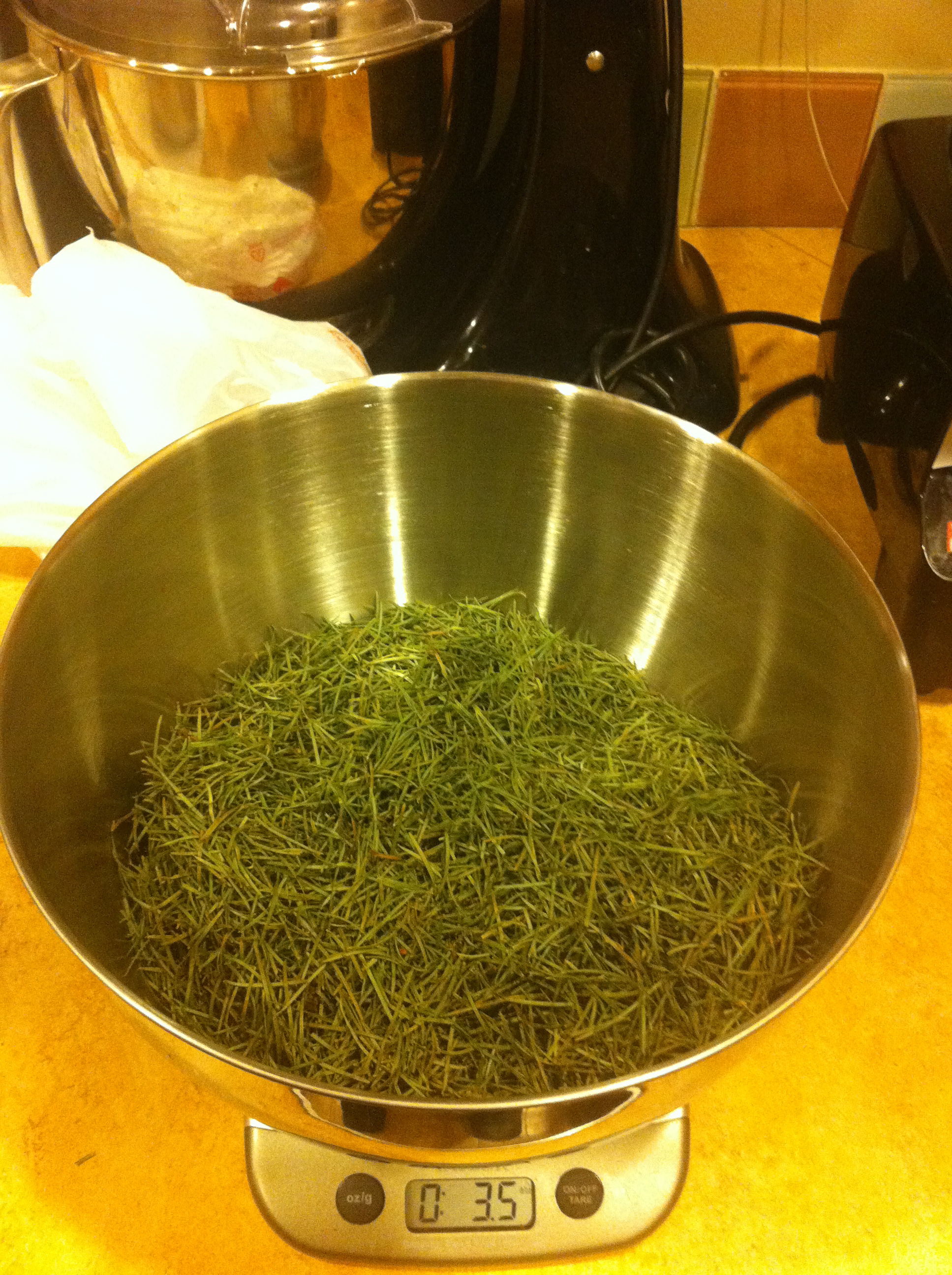
So next up was spruce oil.  First, I weighed out my 3.5 ounces of needles and blanched them.

Bowl of Spruce Needles
Then I added 1 1/4 cup of grapeseed oil.  Wait.  1 1/4 cups.  That makes sense.  I bet the New York Times printed the recipe wrong for the vinegar.  It must have been 1 1/4 cups of vinegar.  Ack.  If I had done the oil first, I would have seen that and made the adjustment.  Ah well.  Anyhow, the oil turned out great.

Spruce Spice

I took some needles and grinded them in my coffee bean grinder.  Exciting!

Sprucing Up A Meal

So now I had my spruce ingredients – what to make?  I riffed off a couple of ideas some friends had for a dish – pork chops with a sour apple chutney and honey roasted root vegetables.  Me?  Sous vide bison rib eye with a cranberry spruce chutney and a honey roasted root vegetable puree.  Booyah!

Sous vide bison rib eye with cranberry spruce chutney and a honey roasted root vegetable purée

After cooking this up, I read the comments on the opinion piece and everyone was pointing out how Christmas trees could be covered in flame retardant and who else knows what.  I did find mine just lying on the side of the road.  Yes, well. I’m still alive so I guess I was lucky.  I think a short drive to the mountains would be a better method next time.  You know, actually, if you get a Christmas tree next year, go cut it down yourself.  You never know if you’re going to eat it later.

Jethro
Happy Holidays!

24 Friday Dec 2010

Posted by jethro in uncategorized

≈ 3 Comments

Tags

Happy Holidays

Happy Holidays from Jet City Gastrophysics

Modernist Cuisine At Home: Smooth Purees, Part II

21 Tuesday Dec 2010

Posted by jethro in MC at home, recipes

≈ 1 Comment

Tags

asparagus, broccoli, Modernist Cuisine, VitaMix

Picking up where I left off from last month, I finished making the rest of the puree recipes from the PDF excerpt of Modernist Cuisine.  Well, almost all of it.  Two remaining recipes involved being sauteed and then blended in a commercial blender.  One required boiling and a Pacojet.  A Pacojet, which quickly purees frozen products to produce a very fine consistency, can be found used online.  For around $2900.  This is out of reach for this home cook, so it will have to wait until, oh, a miracle occurs.

In that last post, I had some issues getting a truly smooth puree.  Then, lo and behold, none other than Dr. Myhrvold himself, the author of Modernist Cuisine, kindly commented that I needed a commercial blender – in particular, a VitaMix – to get the results I was looking for.  How did he know?  He had his team re-test all the purees.  I can just imagine how the chefs felt, having to re-do their work because some frickin’ home cook blogger couldn’t nail it down.  Chefs, if you’re reading this, my apologies.  Just having lots of fun over here!

So I needed to find a VitaMix.  They sell for around $450 new, but that’s pretty steep.  I needed to find one used.  So to the Internet I went.  $300 was the going rate most of the time, but I, master of the bargain, was able to find one at a yard sale for $100!  So take heart, home cooks – miracles do occur.  Just keep your eyes peeled.

And with my VitaMix in hand, I was ready to conquer the next set of purees.

One: Asparagus

Bad Puree

Not So Smooth

As what seems to be a pattern for me, I learned something valuable about cooking this week by messing it up. This time it was over phrasing.  In particular, the instruction “thinly sliced”.  For me, thinly slicing asparagus implies lengthwise.  Otherwise, it would have said “thinly chop”, right?  I don’t think so.  In the first round, the thin stringy fibers of the inside of the asparagus refused to be finely blended, leaving choppy floss and an uneven texture.  So I went back to the store, bought some more, and sliced them appropriately.

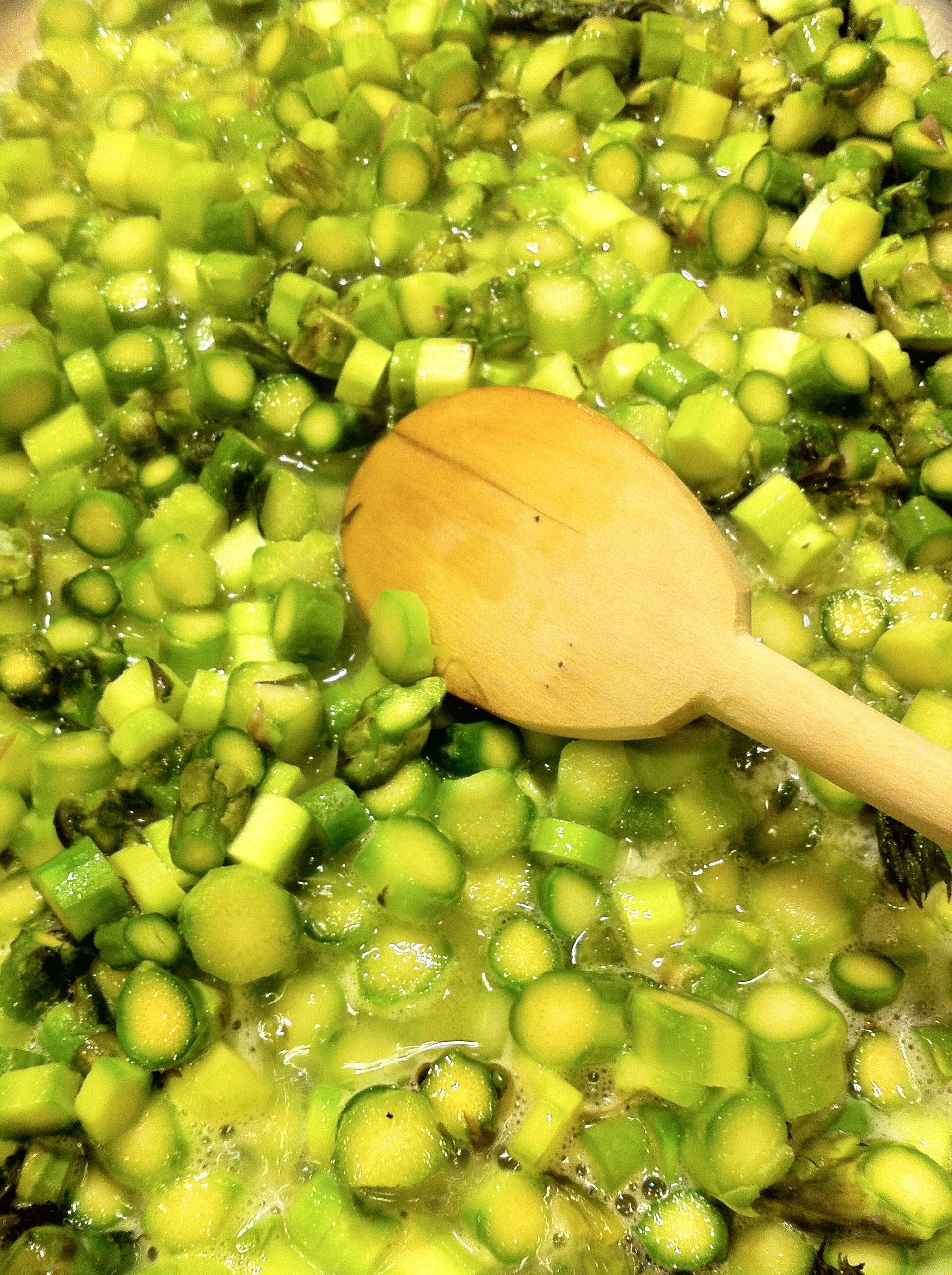
Cooking Asparagus

I gave them a go in my new VitaMix and the smoothest, most beautiful bright green puree presented itself.  These Vitamix’s are awesome!

Smooth Asparagus

This Is Some Seriously Smooth Asparagus

I served it with a 24 hour sous vide pork belly for a dinner with friends and it went over famously.  If you have a VitaMix, go make some. Now.

Two: Broccoli

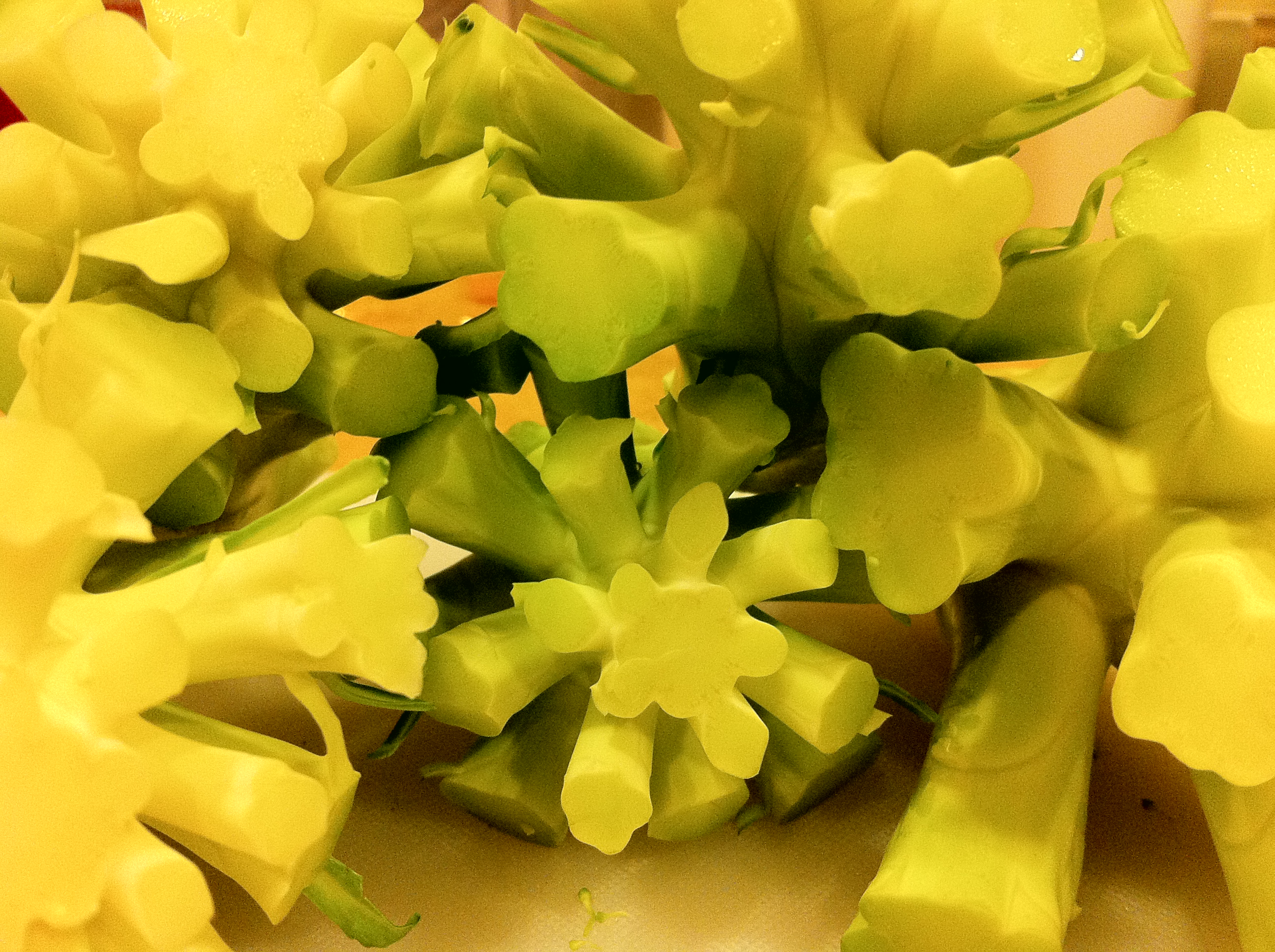
Broccoli Stems

The final puree called for broccoli stems.  At my local chain supermarket, they cut off the stems because they rightly assume the vast majority will just throw it away for the good stuff – the florets.  But as always my trusty Asian grocery store came through and had nice thick stems to use.

I followed the directions, which were very straightforward – saute on medium heat for 12 minutes with a neutral oil.  I looked through my cabinet: canola, pumpkin seed, avocado, olive, peanut…and grapeseed.  There’s a nice neutral standard.  After cooking I put them in the blender and gave them the spin of their life.

A Proper Blender

About To Be Liquified In A Proper Blender

And once again I was rewarded with a thick, creamy, smooth vegetable puree. On the parametric recipe, the asparagus and broccoli recipes point to other pages for reference in the cookbook.  I wonder what they help illuminate.  I know the purees taste great on their own, but I bet it would be fun to do some inverse spherification on them as well.  Maybe that’s what the other pages suggest.  Maybe not.  I’ll have to wait until March 2011 like everyone else.  But I do know that’s what’s up next in my kitchen.

Smooth Stems

Jethro

You Spin Me Right Round: Enter The Centrifuge

13 Monday Dec 2010

Posted by jethro in centrifuge
≈ 6 Comments

Tags

apple syrup, carrot, tomato water

Spin Me Round

A couple of months back, I had a happy sequence of events.  First, I got a raise.  Always a cause for celebration.  Then, the Modernist Cuisine cookbook publishing date was moved from December 15th to March 15th.  Not exactly happy news, but I did set aside $500 to buy it (it has since been reduced to $451.25) that I now had freed up.  And soon after that, I found a centrifuge.

When I had a chance to speak with Chef Maxime Bilet about cooking my way through his upcoming book, he said if I really wanted to do it, I needed to get a centrifuge.  I was totally expecting him to say an immersion circulator.  Perhaps it was obvious that I should already have one.  But OK then.  I began surfing the Internet to see what I could find (the centrifuge posts at Cooking Issues were of great help in focusing in on what I should look for).  Most used centrifuges that have the volume I needed (as opposed to desktop centrifuges that only spin small test tubes) cost around $1000 – $2000 plus freight shipping on top of that.  Way too much to justify.

But I kept looking and stumbled upon a used laboratory equipment company in Seattle that was going out of business.  They had centrifuges in excellent condition going for cheap. I went to the warehouse to check them out and drove away with a frickin’ centrifuge in the back of my car.  A refrigerated unit at that. For $500!

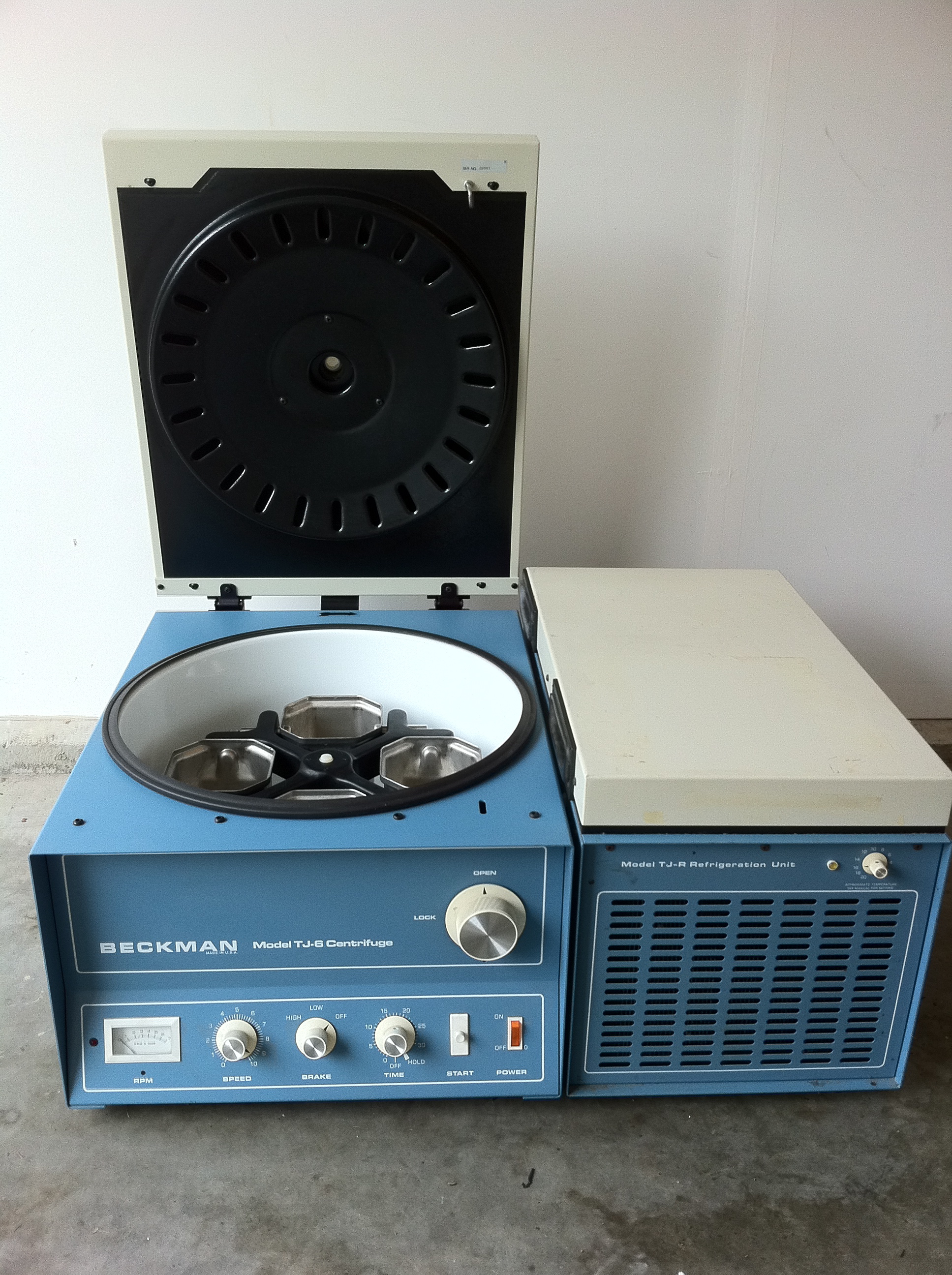
The Unit

The Beckman TJ-6 Centrifuge

An Investment In Future Deliciousness

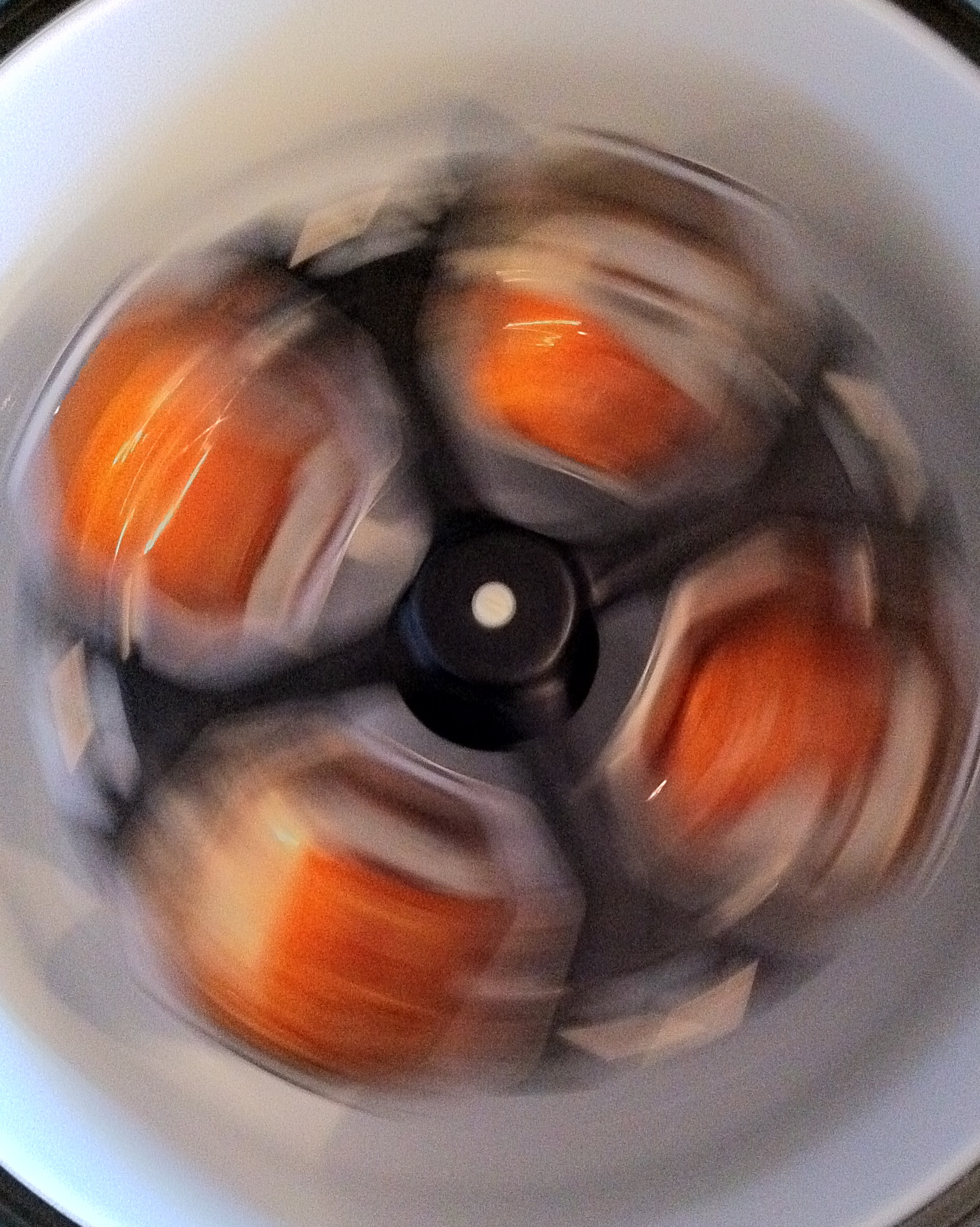
The centrifuge I found was a Beckman TJ-6 with a TJ-R refrigeration unit.  It has four buckets that hold up to 2 liters (about 8.4 cups).  It gets up to 2700 rpm, or 1520 g’s.  It is a large metal beast with a cool 60’s style simplicity.  They really don’t make things like they used to.

The Cooking Issues guy’s tabletop centrifuge pulls about 4000 g’s.  Chef Bilet didn’t think it would be an issue to separate things, but only that I would have to spin longer.  Well, only one way to find out.

The Search For Spin

Now, I should step back for a moment and answer the question: why do I need a centrifuge in the first place?  A centrifuge’s principle purpose is to separate substances based on density.  Heavier substances, called the pellet, collect at the bottom, while lighter substances, or supernate, collect at the top.  Culinary purposes include extracting oils from nuts and separating cream from milk.

To use my new beast, however, I needed to find suitable containers for the food to be spun in.  The guys over at Cooking Issues settled on sealed vacuum bags.  I tried the bags I had on hand using some carrot juice, but they were too small so the pellet and supernate wouldn’t separate fully.

False Start

A False Start

I searched my local supermarkets and found some small Ziploc containers that fit into the buckets nicely.  The lids were just a bit too wide, but the body was good enough.  I filled them up and spun them.  Turns out it was not good enough.  I immediately heard a crack inside the machine. Centrifuges can be very dangerous with objects spinning at such high speeds.  It is said what you pay for in a centrifuge is the housing in case of an accident.  And accidents do happen.

I immediately turned it off and left the room.  After a couple of minutes, I came back in and checked to see what had happened.  The problem was the centrifuge worked perfectly: as it created over 1500 g’s, the sides of the lids were crushed and the containers snugly fit themselves into the bottom of the buckets.

I kept searching and found some plastic containers at Storables that fit in the buckets and didn’t crush when spun.  Finally I could start seeing what this ‘fuge could do.

Procuring Pellets And Supernate

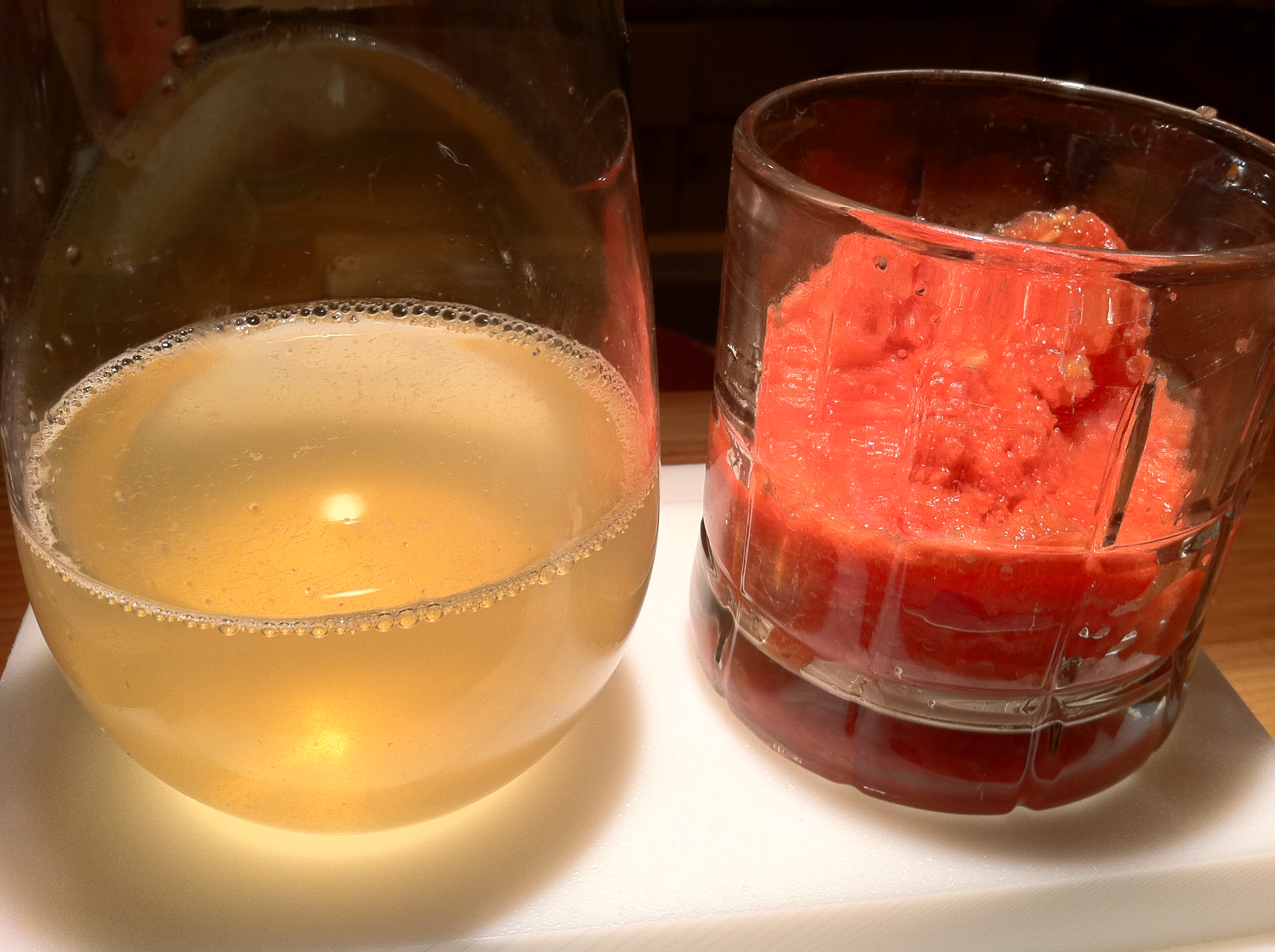
One use of a centrifuge: ‘instant’ tomato water.  Usually you let a puree of tomatoes sit in a cheesecloth over a bowl for 8 to 24 hours.  With a centrifuge: 30 minutes or less.

Tomato Water and Paste

Tomato Water and Paste

You also end up with a nice tomato paste to use however you wish.  I made a caprese martini: an instant liquor infusion of basil and vodka with spun tomato water in a chilled martini glass lined with olive oil and salt.  Deliciously awesome. So good my best friend put it on the menu at his bar.  New Cookery finds its way to the masses!

I also took the sous vide apple puree I made and spun it.  The result: a thick sweet apple syrup.  The ‘pellet’ of apple puree left was incredibly thick and just as good as before.

Apple Syrup

I’ve also taken fresh carrot juice and ‘fuged it.  I was left with a thin carrot paste at the bottom of the containers.

Carrot Paste

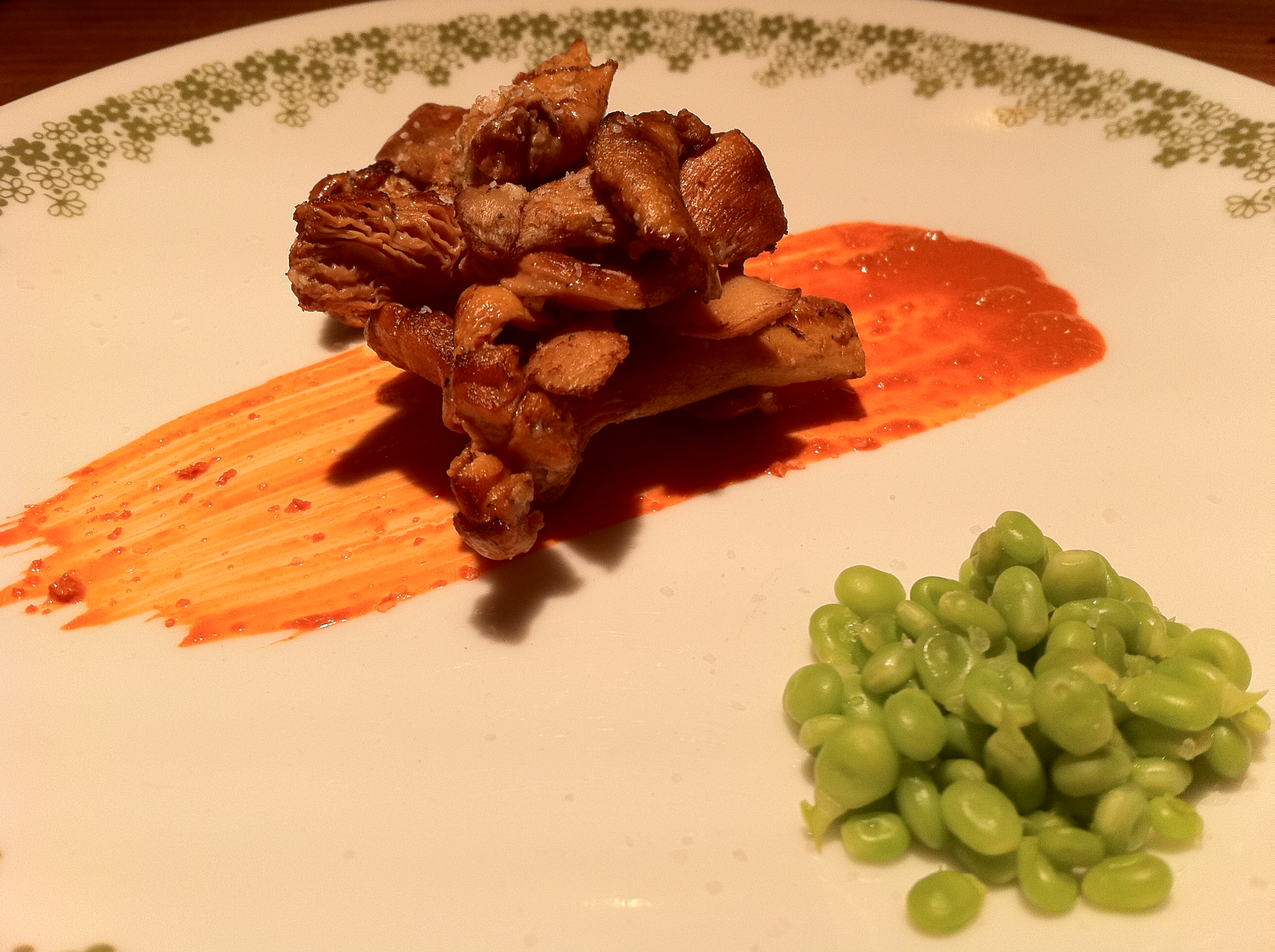
I didn’t know exactly what to do, if anything, with it.  I remembered watching Katsuya Fukushima and Ruben Garcia from Minibar on Iron Chef and they said something interesting on their approach to cooking: “The fish talk to us and say, we want to be cooked that way.”  So I looked at this paste and said “what does this look like”?  And it looked like paint.  I guess it wanted me to paint with it. So, I did.

Chanterelle Mushrooms with Peas and Carrot

A Little Snack: Chanterelle Mushrooms with Sugar Snap Pea Ovules and Carrot...Streak?

A streak of carrot paste, topped with hand foraged chanterelle mushrooms and the seeds (or ovules) from sugar snap peas.  It was great.

But I also realized I have fallen off the deep end.  I mean, I centrifuged carrot juice and took sugar snap peas and de-seeded them by hand just for a small meal alone at my house.  I’m done for. I’ve lost the plot. I’ve been spun crazy.

Jethro

Modernist Cuisine At Home: Dragon Fruit Chips

09 Thursday Dec 2010

Posted by jethro in MC at home, recipes, sous vide, starches

≈ 4 Comments

Tags

chips, corn starch, dragon fruit, Modernist Cuisine

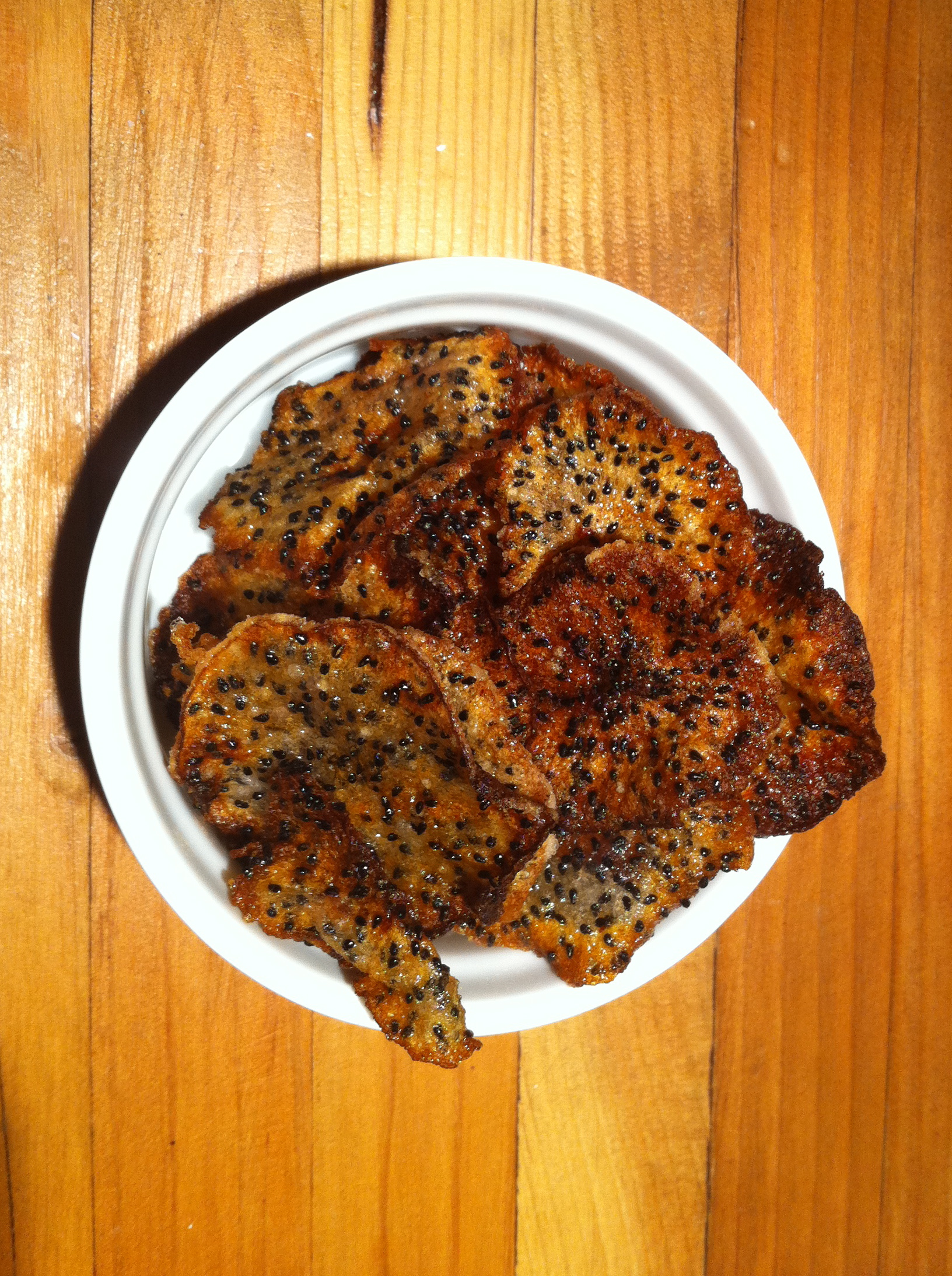
Bowl of Dragonfruit Chips

About a month ago the team at Intellectual Ventures put up an interesting blog post about frying watermelon to make watermelon chips.  With nothing more fancy than a vacuum sealer, this seemed like a perfect recipe to try out at home.

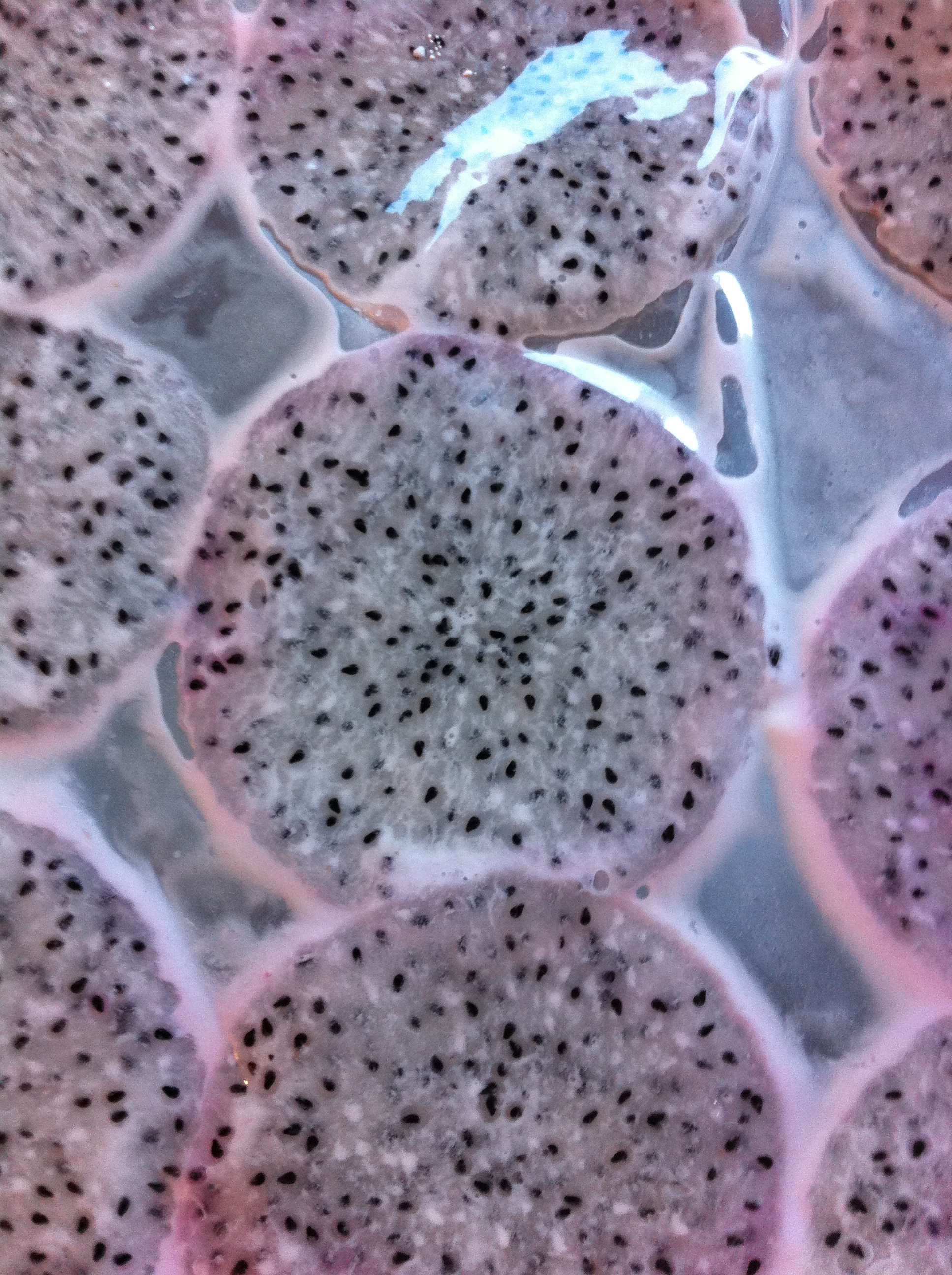
The concept behind the watermelon chip is that starch is what makes a chip a chip, whether it’s corn or potato or even parsnip and taro.  Fruit, however, does not have the high starch content that these vegetables have (yes, a potato is a vegetable).  Using vacuum compression, starch can be infused into the fruit, and make it suitable for frying.  They settled on watermelon.  I decided on dragon fruit.

Fruit Fry

The steps are simple enough:

  1. Thinly slice the fruit
  2. Apply a starch slurry to the fruit
  3. Vacuum seal and let rest for 30 minutes
  4. Deep fry

I went to my local Asian supermarket and nabbed a dragon fruit.  I then had it thinly sliced on a meat slicer.  Here I pulled some strings: I don’t have a slicer at home, so asked my best friend who owns a bar if I could come in and borrow his for a minute.  I’m sure I could have just cut it thinly myself, but I wanted to nail it.  Sometimes it’s more fun to make it more complicated.

Next up was starch.  In the blog post, Chef Zhu says he’s using something and water.  Did he say Crisco?  Or maybe Cryscoat?  One check on the web and it turns out that Cryscoat is a “nickel-containing zinc phosphate for steel and zinc-coated steel, applied by spray or immersion prior to painting”.  So, probably not that.  Screw it I thought – I’ll just use the cornstarch in my cabinet.  Sometimes it’s easier to not make things too complicated.

Starch Slurry

I took the dragon fruit slices, which were awfully thin and delicate, applied the starch to either side, and placed them in a sealing bag.  Which I then sealed up.

Compressed Dragonfruit

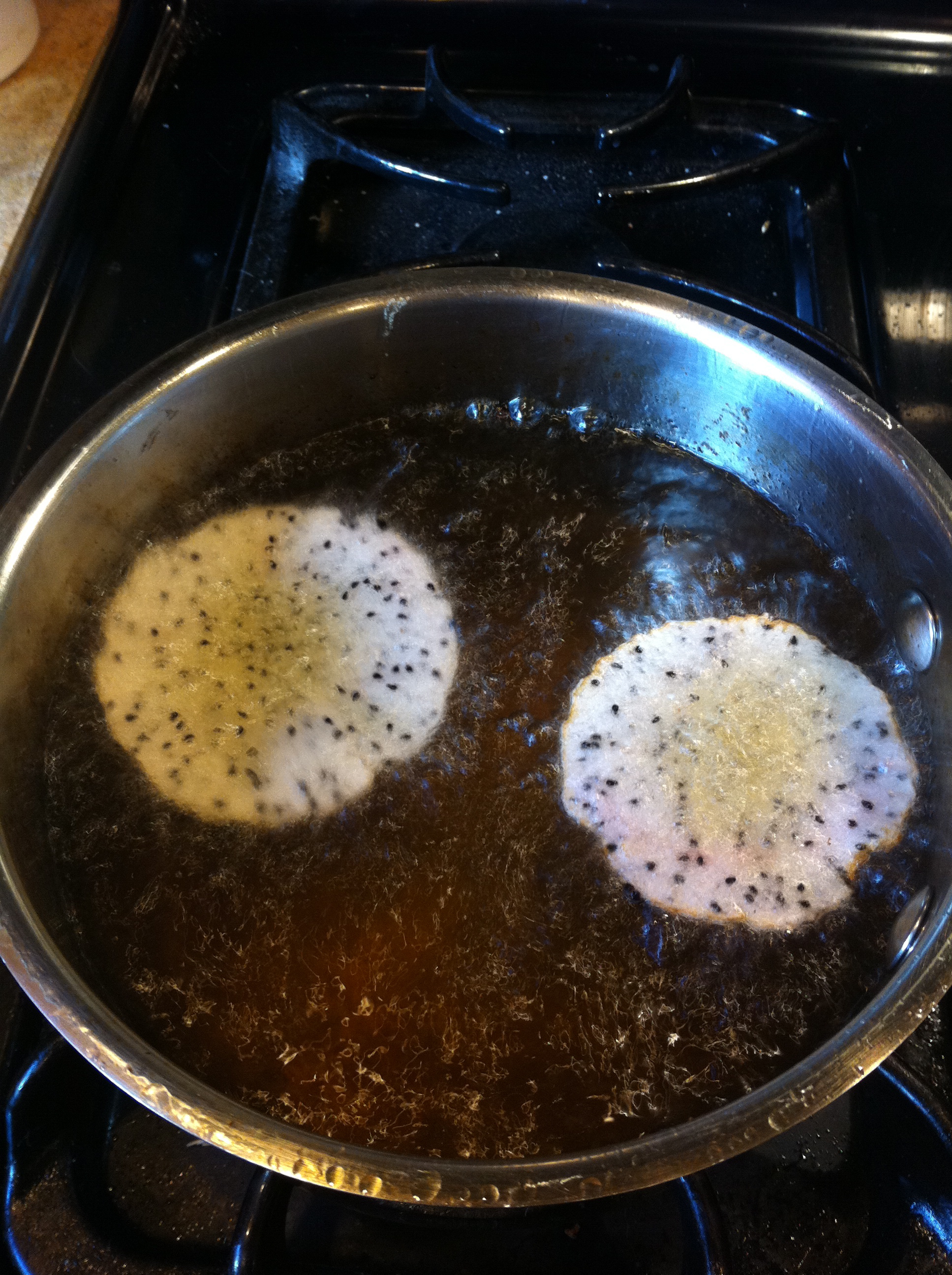
After 30 minutes I fried them up on the stove.  They liked to stick together so I found it easier, though more time consuming, to only do 2 or 3 at a time.

Dragonfruit Frying

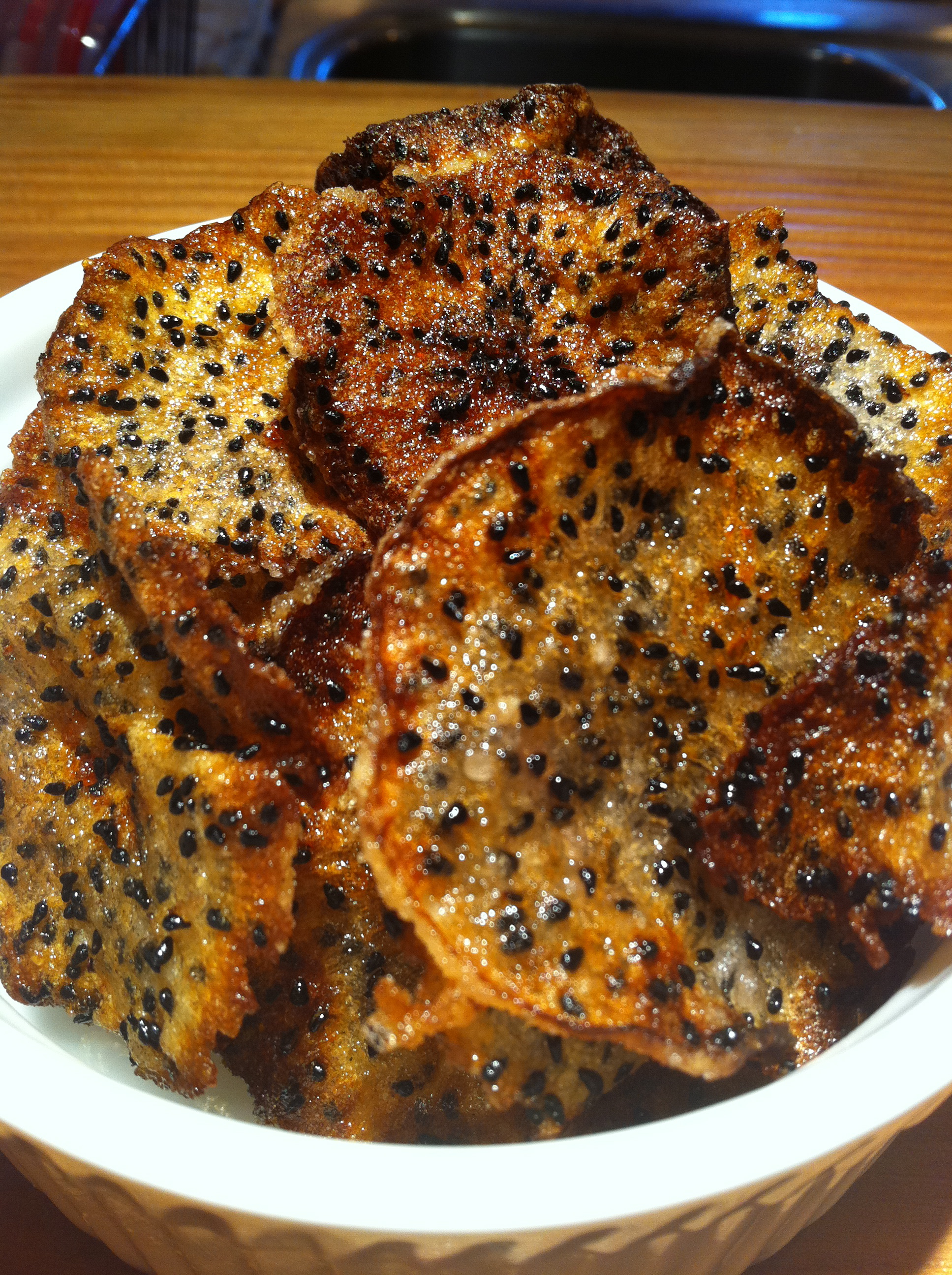
And after I let them dry out and crisp up, I had some amazing dragon fruit chips.  The sweetness of the fruit came through, with the added texture of the seeds, which also imparted a sesame-like flavor to the chip.  Excellent and delicious.

I’m looking forward to their completed cookbook to see what other ideas they have for transforming foods into flavors and textures they’ve never been before.  In the meantime, however, I’ll just try and cook the examples they keep throwing out at us.

Dragonfruit Chips

Jethro

Meeting Eight: Putting It All Together

07 Tuesday Dec 2010

Posted by jethro in blow shit up, sous vide

≈ 1 Comment

Your Jet City Gastrophysics Crew

Your Jet City Gastrophysics Crew

Eric, Scott and I met for our eighth meeting at the end of November to start putting together everything we’ve learned together over the year for a master project.  A thesis project, if you will.

Putting It All Together

Putting It All Together

We’re pretty excited about it and we’ll post more about it in the future.  Otherwise, I was the happy recipient of the latest version of Scott’s DIY immersion circulator.  This one is cased in aluminum, otherwise known as ‘Jethro Proofed’ because of my unique ability to break things.

Circulator 3.0

Scott's Latest Version of the DIY Circulator

We also exchanged other early Christmas gifts as well as distributing our collection of foodstuffs amongst ourselves: fresh ceylon cinnamon from Costa Rica, homemade chocolates, transglutaminase, sodium alginate, Ultratex 3 and maltrodextrin.  Teamwork has its benefits.

Powder Exchange

Our next few meetings will be concerned with our developing thesis project, so we’ll wait to post on the project as a whole instead of meeting updates.  We’re looking forward to it!

Jethro

Following Ferran: Cooking From El Practico

30 Tuesday Nov 2010

Posted by jethro in recipes

≈ 1 Comment

Tags

El Practico, Ferran Adria, flank steak, pork fat, potato stew

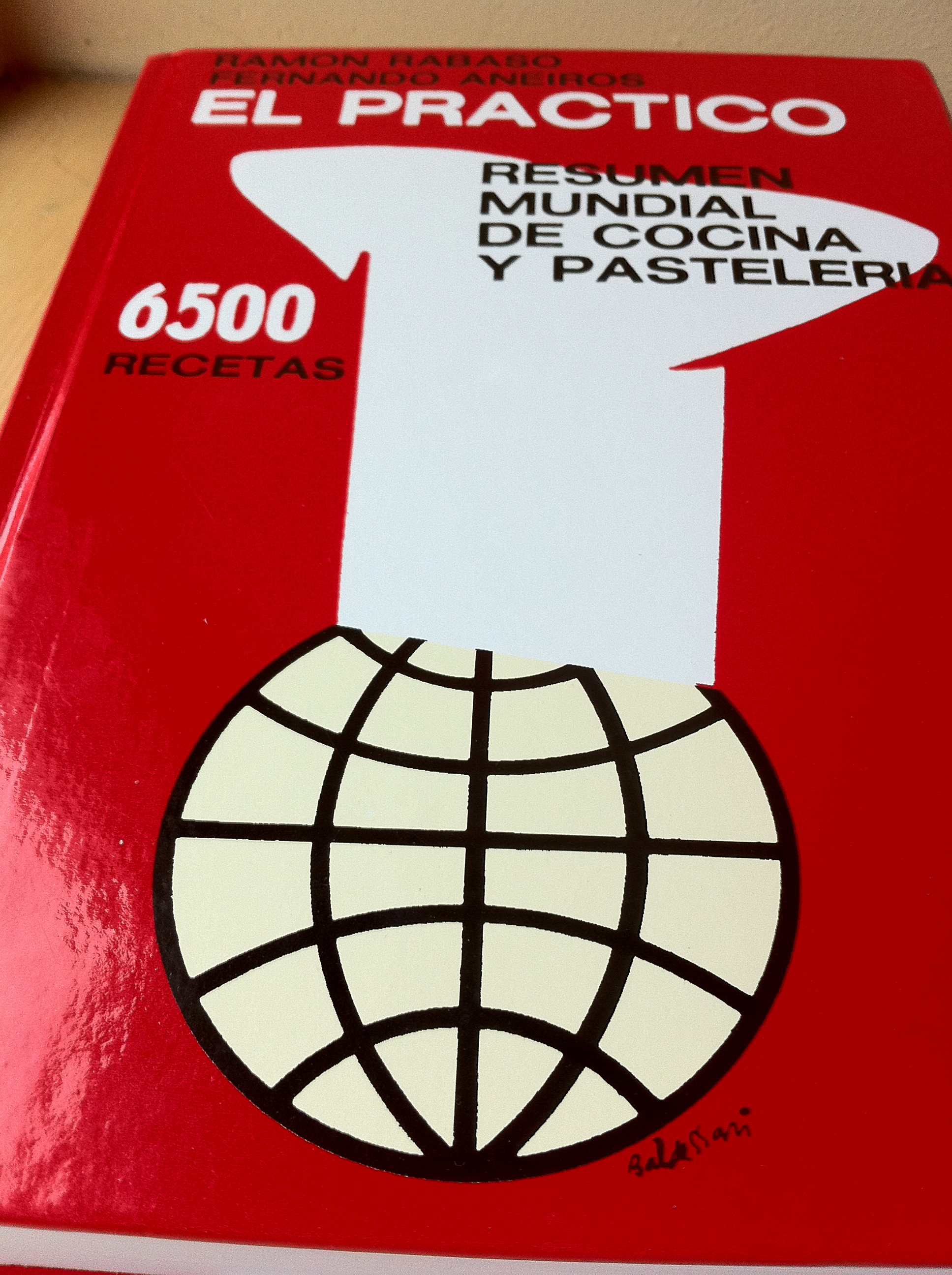
El Practico

…I am grateful to him for having given me a big fat book five hundred pages long to read and learn.  A book of classic recipes, sixty-five hundred of them, a mix of traditional Spanish cooking and dishes heavily influenced by French cuisine…I still have the book.  It has a red hardback cover. It is called El Practico.  The pages are frayed.  The spine is cracked.  But I have it in a prominent place, always at hand, in my laboratory workshop in Barcelona.

–  Ferran Adria, The Big Red Book, or El Practico from How I Learned To Cook

Ferran Adria began his cooking career by landing a job in a hotel kitchen in order to save money to spend a summer partying in Ibiza.  Ibiza is a hedonist island wonderland just off the coast of Spain. It’s a wild, endless fiesta filled with bars, babes and beaches.

I know this.  I spent a weekend there about ten years ago.  My last night there I danced until dawn at Space, an indoor/outdoor club where airplanes from the nearby airport would launch overhead, sending the crowd into a frenzy.  I barely made it out alive.  Spainards are a different breed when it comes to being “a friend of the party”.  I can’t imagine an entire summer there.  Although I did try my best.

One can understand the motivation for a soccer obsessed high school dropout like Ferran. So he took the job as a dishwasher.  The cook, Miguel Moy, had a short temper and would explode at the slightest deviation from the expected way of doing things.  With his demand for excellence, he gave Ferran a copy of El Practico to memorize.

The first food Ferran ever cooked by himself for other people was a stew of flank steak and potatoes that he prepared one evening for the staff meal.

– Colman Andrews, Ferran

The first dish I learned to make was a potato stew. Miguel did not trust me at this stage to cook for the clientele. This was the food for the staff of the hotel…

–  Adria, The Big Red Book

When I read these passages, I thought I could gain an unique insight into the methods of the best chef in the world by creating his first dish. So I decided to hunt down El Practico, find the recipe for potato stew, and cook it up.  And, as always, things got more complicated than they seemed.

Hunting Down The Stew

The first step was finding the cookbook itself.  I had to hunt down the author’s names to make sure I was going to buy the right book.  I briefly lived in Madrid (around the same time as my trip to Ibiza),  so I used my connections there to find the book in a local shop.  Alas, no luck.  So I went online. It took a while but I finally found a copy, and after debating the price for a few days, finally let my culinary curiosity get the better of me and ordered it.

They had a difficult time fulfilling the order and it didn’t land on my doorstep for about six weeks.  I was very excited when it finally arrived in the mail.

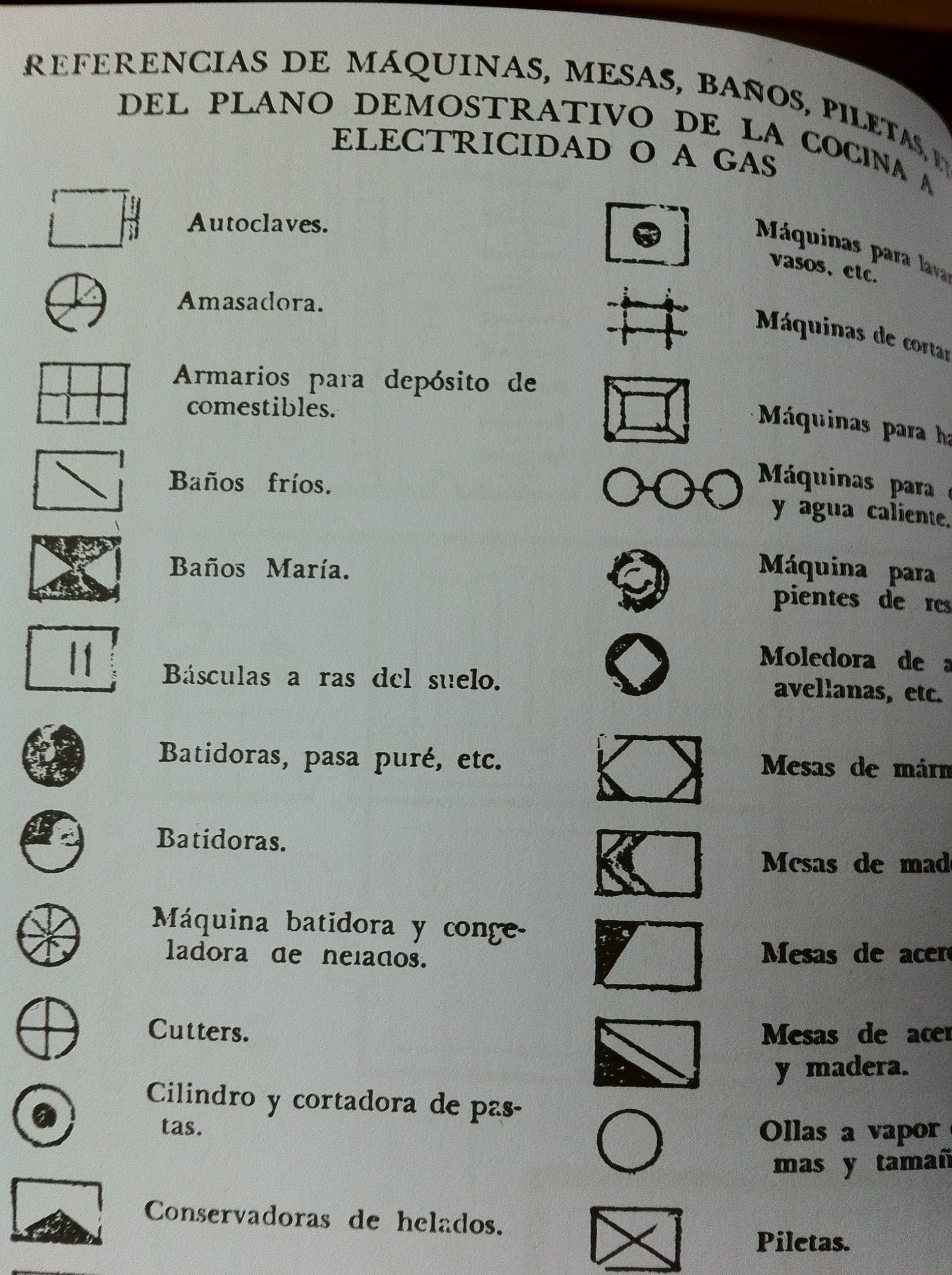
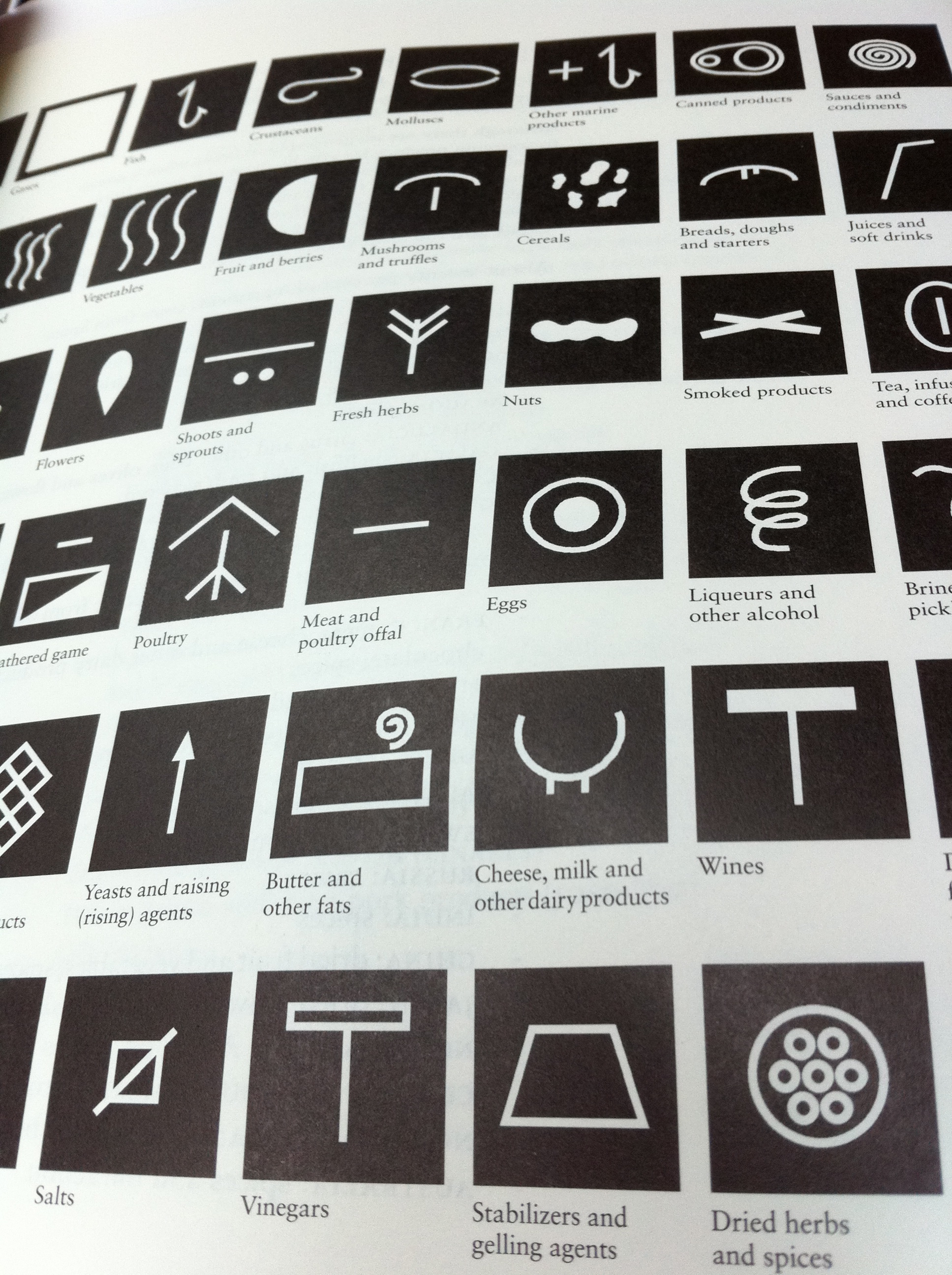
One thing I noticed right away was at the beginning of the book.  A page full of symbols, representing what I gathered were elements of a professional kitchen.

Graphic Chart from El Practico

This page immediately reminded me of something I saw in A Day at elBulli: a set of symbols used to classify different product families of ingredients.

elBulli Graphic Chart

Could have this system received its original inspiration from the pages of El Practico?  I do not know, but the similarities are striking.

So there I was, holding Ferran Adria’s prized cookbook in my hands, the cookbook that inspired him to become a better cook, to become the best cook. I flipped through the pages.  A cornucopia of culinary knowledge.

If only I could read Spanish fluently.

I knew ‘potato’ was patatas in Spanish, so I looked it up in the book’s index, and flipped to page 449, where they had five and a half pages of short recipes for potato dishes.  117 dishes, to be exact.  Which was the stew?  I found that caldo means ‘broth’, so I read and re-read all 117 dishes looking for the word caldo.  I found three: Lard, Paysanne, and Savoyarde.  The only one that had meat in it was Lard, which had bacon.  OK, bacon – kind of like jamón serrano, I thought.  It’s not flank steak, but it’s close.  Perhaps this was his first dish.  But it seemed less like soup and more like a potato side dish.  Maybe I was looking in the wrong section.  So I turned to Sopas, or ‘Soups’.  Once again, as far as I could tell, no luck.

Next I turned to my Spanish speaking friends and asked what they would call Potato Stew with Flank Steak. Perhaps it was cocido, consome, or caldo. Maybe for meat they used churrasco, bistec, or filete.  Look for estofado or guiso. It could be in French: ragoût de pommes de terre or pot au feu.  And so I kept ‘reading’, searching for a recipe that would have all the elements I was looking for: potatoes, stew, and flank steak.

Ferran was right – a lot of the dishes in El Practico are French (and published in Buenos Aires by the way, so not really a Spanish cookbook at all).  I came up with an idea: I could use my copy of Larousse Gastronomique to read the French recipes to see if they were what I was looking for.  Finally, on page 323, I found a meat dish that could be served as a stew, which contained potatoes: Navarin.  Navarin is a French ragoût (or stew) of lamb or mutton.  I figured he could have substituted flank steak for lamb.  It didn’t have to perfect – it was for a staff meal after all, right?  It must be it.

From Spanish To English To Food

The Recipe

El Practico was first published in 1928, so the recipes reflect that: no measurements or steps, just short conversational sentences on how to put it all together.  A good set up for a dishwasher making his first stew, as it allows a lot of leeway. I translated the recipe with the help of Google and my meager Spanish cooking vocabulary.

Pedazos de pecho, paleta, etc. de cordero o carnero.  Sazonar con pimienta y sal. Saltear a la grasa de cerdo.  Escurrir.  Deglacer al vino blanco.

Brisket pieces, chuck, etc. lamb or mutton. Season with pepper and salt. Saute the pork fat. Drain. Deglaze with white wine.

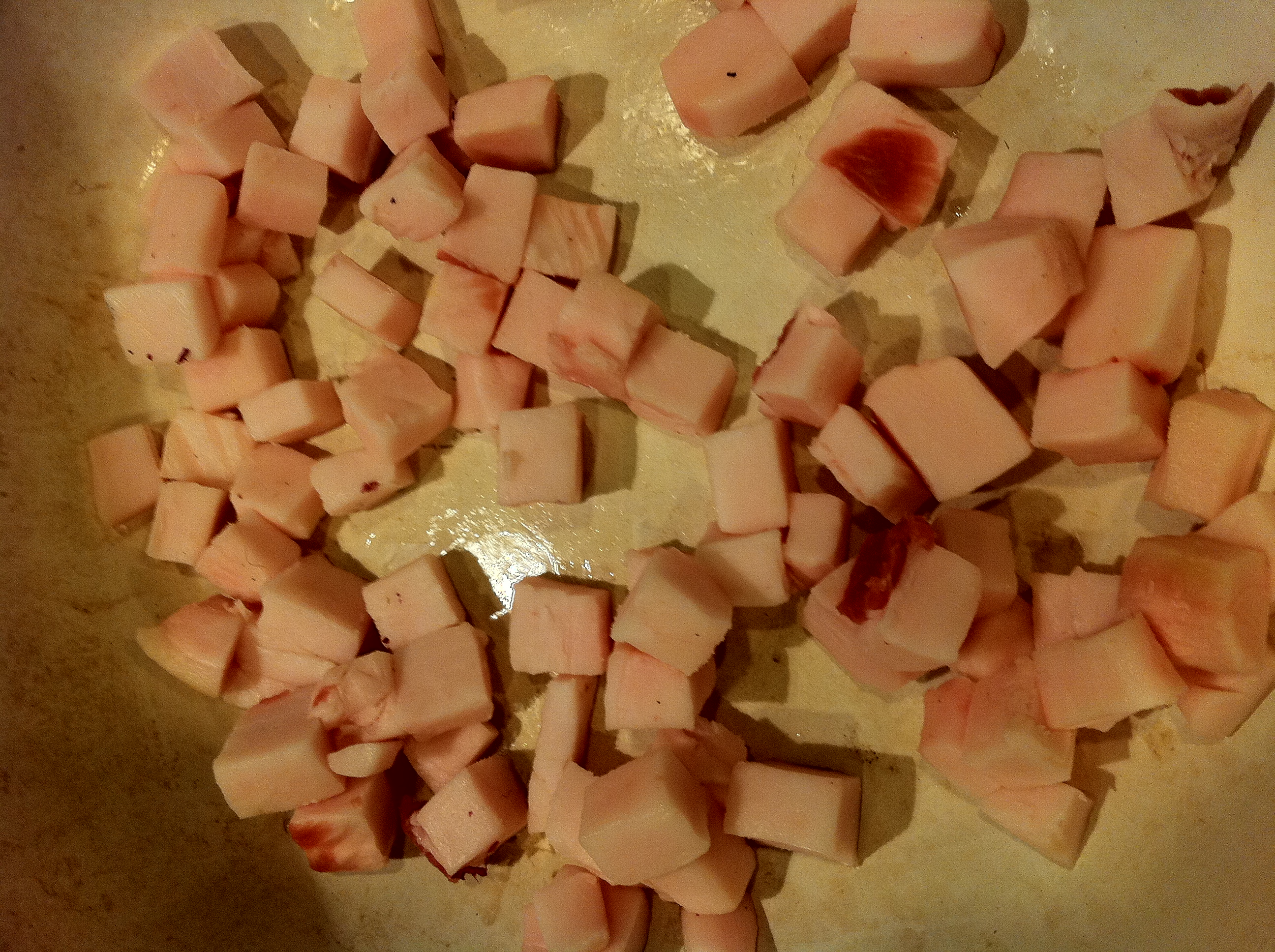
Pork fat.  For most people, that would entail some research to find and purchase.  I, however, live right next to an Asian grocery store.  I knew, having never bought it before, that they would have it.  Sure enough, they did.  So I began cooking it up.

Pork Fat

Next came sauteed onions, the flank steak, potatoes and a bouquet garni (what else could give it away as a French dish?).  I also added pearl onions, turnips and carrots.  No need to follow it to the letter.  I mean, I’m just cooking a staff meal.

After it cooked for a while, I removed all the meat and vegetables to another dish, reduced the stock, and added it back to let it simmer a while longer.  And soon I had a potato stew with flank steak.  Ferran Adria’s first dish.

What I learned was his cooking, like most all Western chefs, is informed by French techniques. Having spherified coffee, root beer and melon juice earlier this year, it was enlightening to return to Ferran Adria’s roots, and see, like all artists, that he began with the basics, and it is from that foundation that he has launched his culinary innovations.

And that foundation, I might add, is pretty tasty.

Jethro

Modernist Cuisine vs. Burger King

20 Saturday Nov 2010

Posted by jethro in uncategorized

≈ 3 Comments

Tags

Burger King, burgers, Modernist Cuisine

Is Burger King going to market Modernist Cuisine’s ultimate cheeseburger, or is Modernist Cuisine going to reveal the secret recipe for the Whopper?  Mm.

Modernist Cuisine At Home: Smooth Purees, Part I

12 Friday Nov 2010

Posted by jethro in MC at home, recipes, sous vide, vacuum sealing

≈ 7 Comments

Tags

apples, artichokes, beets, Modernist Cuisine, puree

Apple and Beet Purees

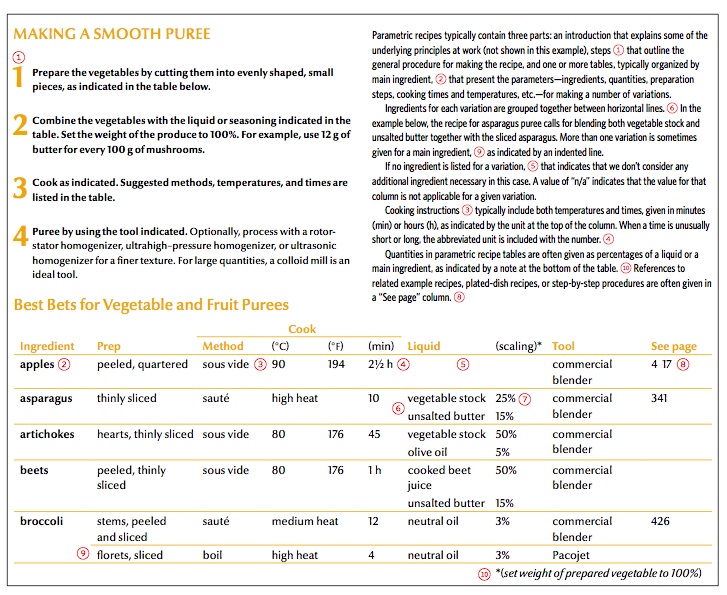
Last month I began to cook my way through the upcoming Modernist Cuisine cookbook by using their PDF excerpt they made available for download.  Out of the three recipe examples given, only two have enough information to make them in their entirety.  First I created their recipe for instant hollandaise.  Next up: their selection of recipes for smooth purees.  Out of the five fruits and vegetables listed, three are prepared sous vide.  I decided to do those first, because any chance to use my vacuum sealer makes it worthwhile for it to take up a huge chunk of my counter space.  The saute recipes will be covered in Part II.

The recipe

Let's Get Smooth

The recipe for pureed fruits and vegetables is an example of what they call a parametric recipe.  This type of recipe gives a basic concept with several variations in an at-a-glance format.  This way you can understand the basic concept and run with it.  As they say in the excerpt:

We feel the parametric recipe is a strong concept for an instructional cookbook. Such a recipe does more than merely suggest methods for making one dish the same way again and again— it reveals the pattern and reasoning behind the chosen ingredients and methods, and thus makes it clearer how to apply those lessons in other circumstances. The parametric recipe thus takes the master recipe to a more detailed level, and serves as a launching point that allows you to change ingredients and quantities in a number of ways to produce dozens of variations.

That’s right up my alley – taking these new techniques and understanding the fundamental idea behind them, so they can be applied to whatever I’m cooking.  I love this book already, and it’s only a PDF file.

One: Artichokes

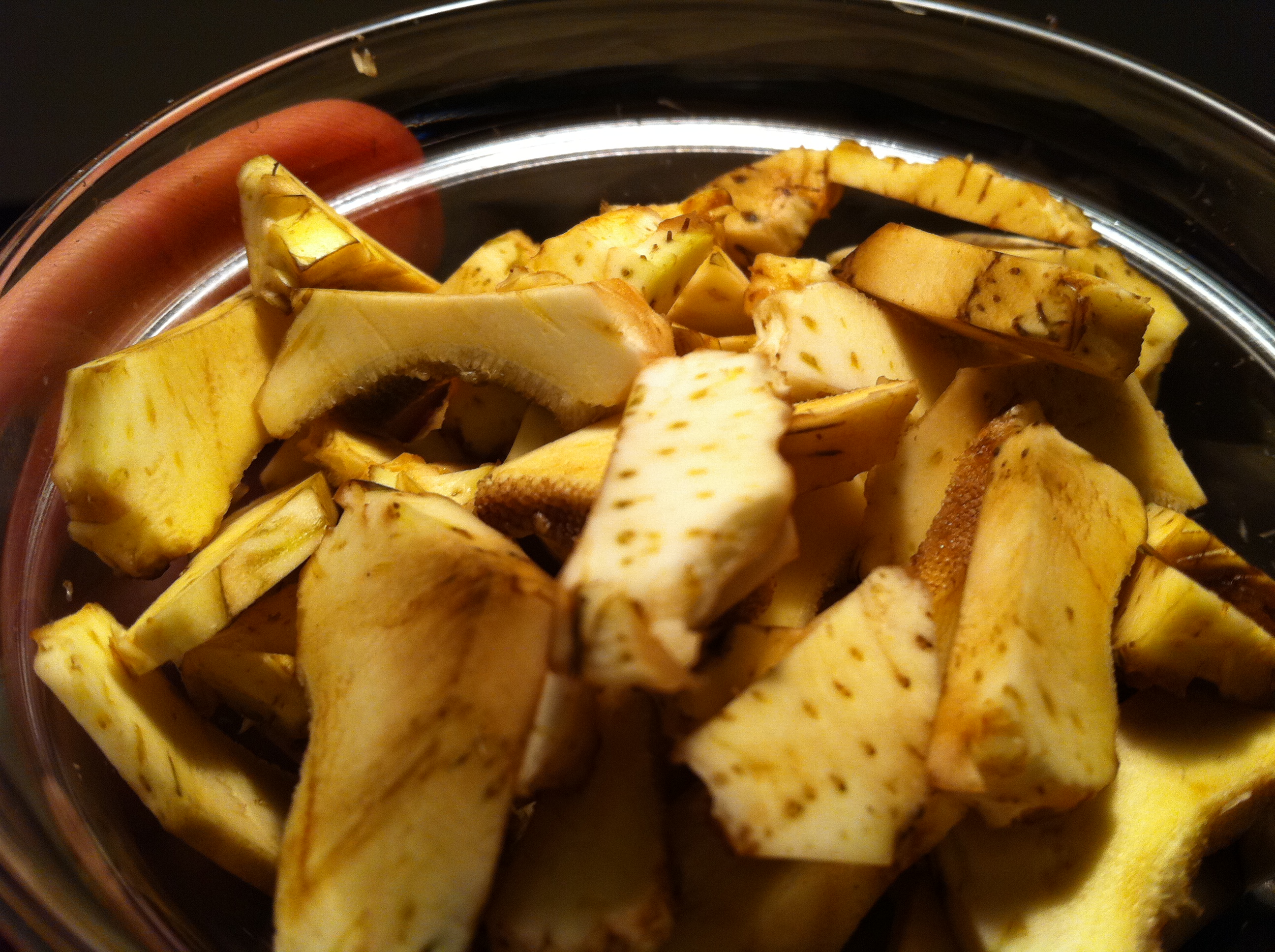
Artichokes

Well, wouldn’t you know it.  Artichokes are out of season around here at the moment (the peak season is August through October).  But we have a variety of different grocers; there must be someone who has some.  Sure enough, Whole Foods had some packaged baby artichokes available.  Is one package enough?  I eyeballed it and thought it looked OK to me.

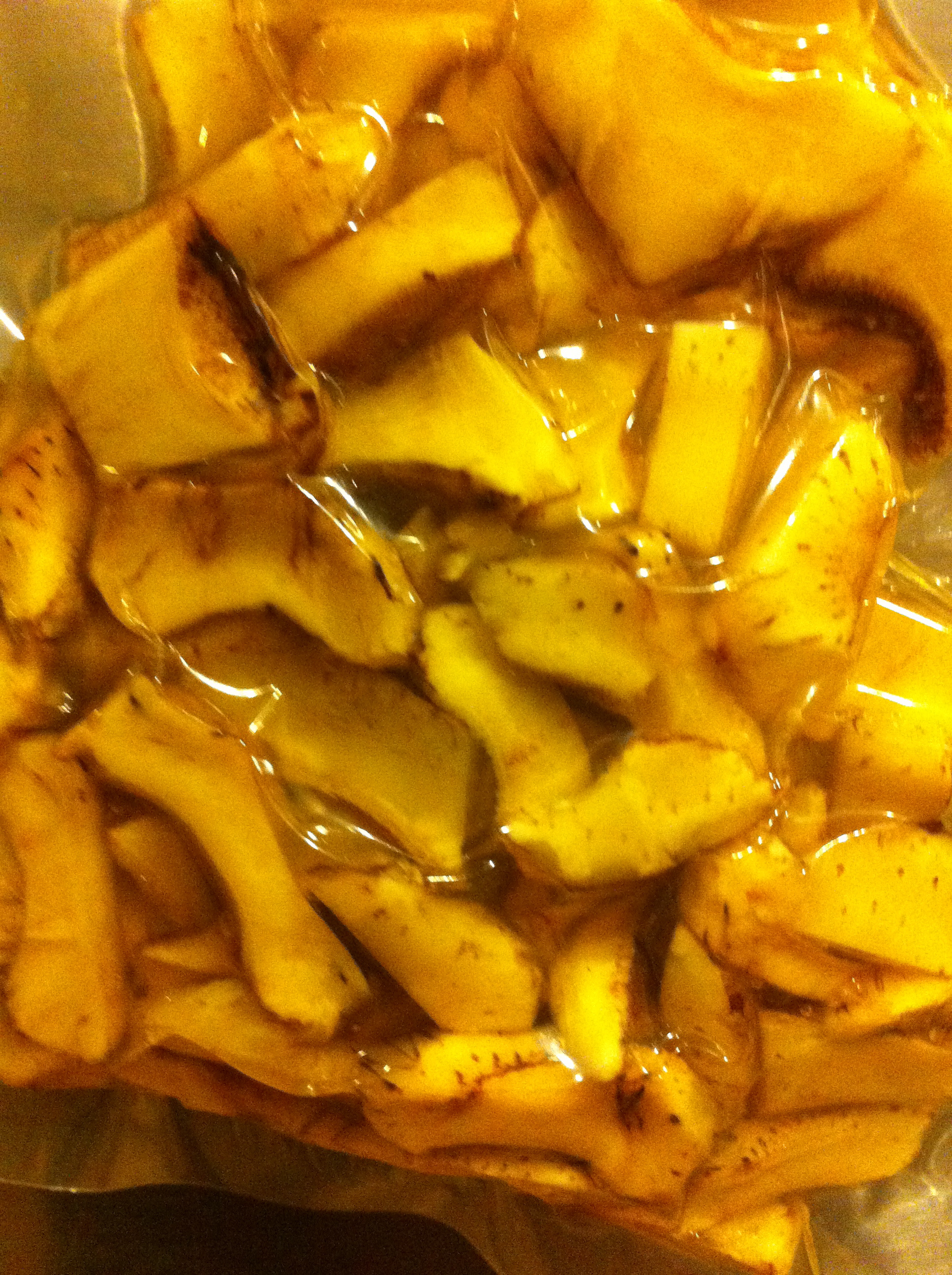
The process was simple enough: get the hearts out and thinly slice them, vacuum seal them with vegetable stock and olive oil, and drop them in a sous vide bath.  The scaling directions are so great.  You set the veggie to 100%, and add the other ingredients in the correct proportion, no matter how big or small the quantity.  In my case, these baby artichokes didn’t give up much in the way of meat, but I dutifully went ahead and prepared them.

Sliced Artichoke HeartsSealed artichoke hearts

After sitting in the water bath for 45 minutes, I put them in the blender, and promptly had my first puree fail.

Puree Fail

Does This Look Smooth To You? Yeah, Me Either.

Turns out that you really need more than a few baby artichokes to create the volume necessary for the blender to blend well.  I’m just a guy cooking at home and this recipe is aimed at culinary professionals who need to crank out 400 covers a night.  The recipe just doesn’t account for single servings.  Fair enough.  I’ll have to wait until they’re back in season and try it again. It was a decent enough spread and I ate it within a few bites.

Two: Beets

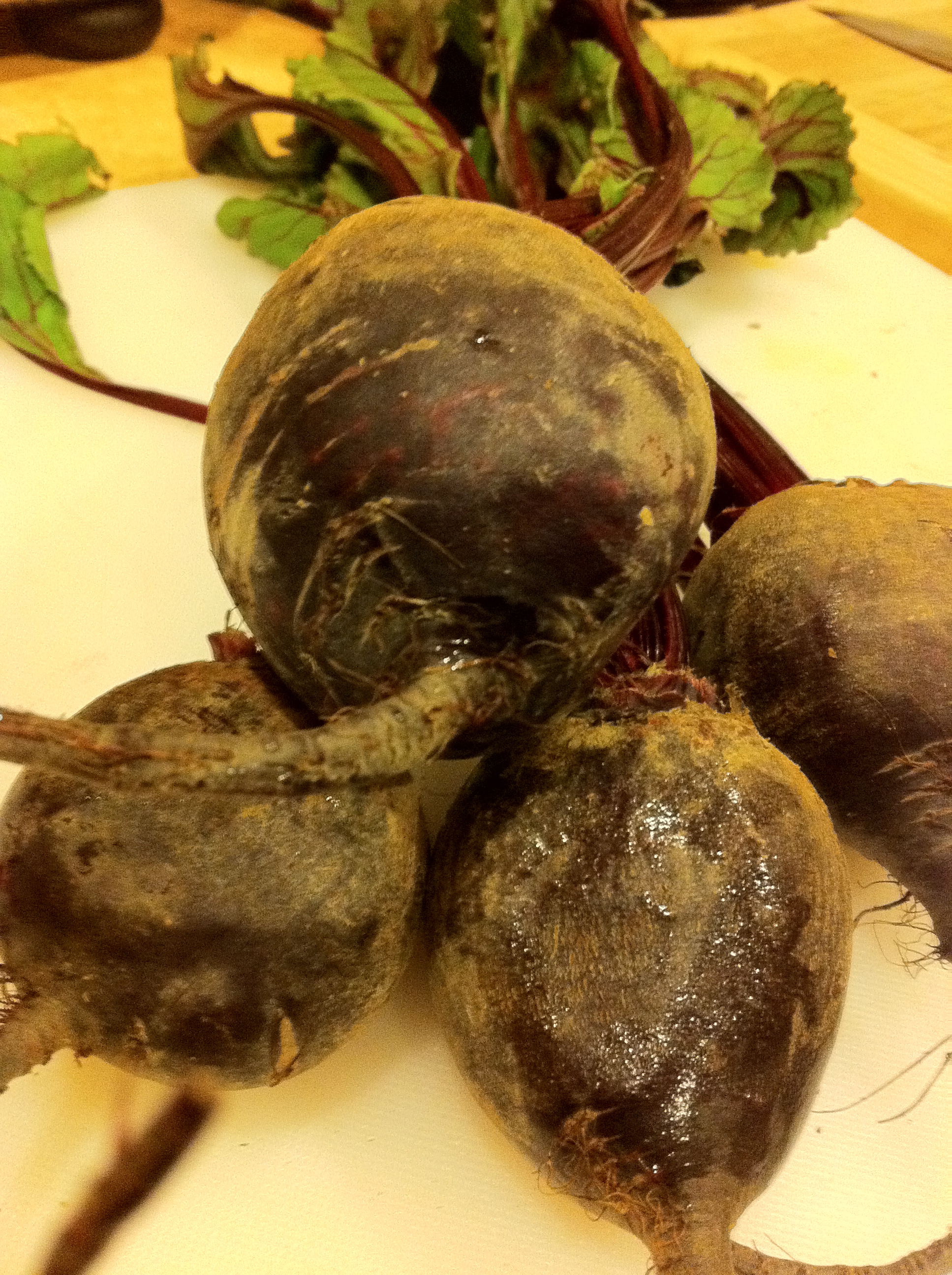
Undaunted, I moved ahead to the next one on the list (and conveniently needing the same temperature water bath). Once again, the first part of the directions was simple enough: peel and thinly slice some beets.

BeetsSliced Beets

The next ingredient was interesting: cooked beet juice.  Why cooked beet juice?  As the book isn’t published yet, I don’t know.  Well, OK then. I juiced a beet and cooked the juice.  All this fuschia foam developed and floated on the juice.  Should I discard it?  Probably.  So I skimmed the top, added the juice to the beets with butter (all carefully measured with a digital scale of course) and sealed it up.

Beet JuiceSealed Beets

After an hour in the sous vide bath, I pulled it out and put it in the blender, where unlike the artichokes, it did its magic well.

Beet Spin

I had my first puree of sous vide beets.  It definitely had that earthy beet flavor, and an intense bright color , but the texture was a bit…oh, grainy?  Maybe sandy is a better word.  Somehow I was expecting a texture like pudding – perfectly smooth.  Is this the correct texture?  Perhaps when the recipe calls for a commercial blender, they mean a Vitamix or Blendtec mixer.  Most likely it’s meant as a base for something else, and not meant to be eaten alone. I don’t know for certain, but certainly, it isn’t bad at all – just not what I was expecting.  As a matter of fact, I see a borscht in my near future.

Beet Puree

A Beautiful Beet Puree

Three: Apples

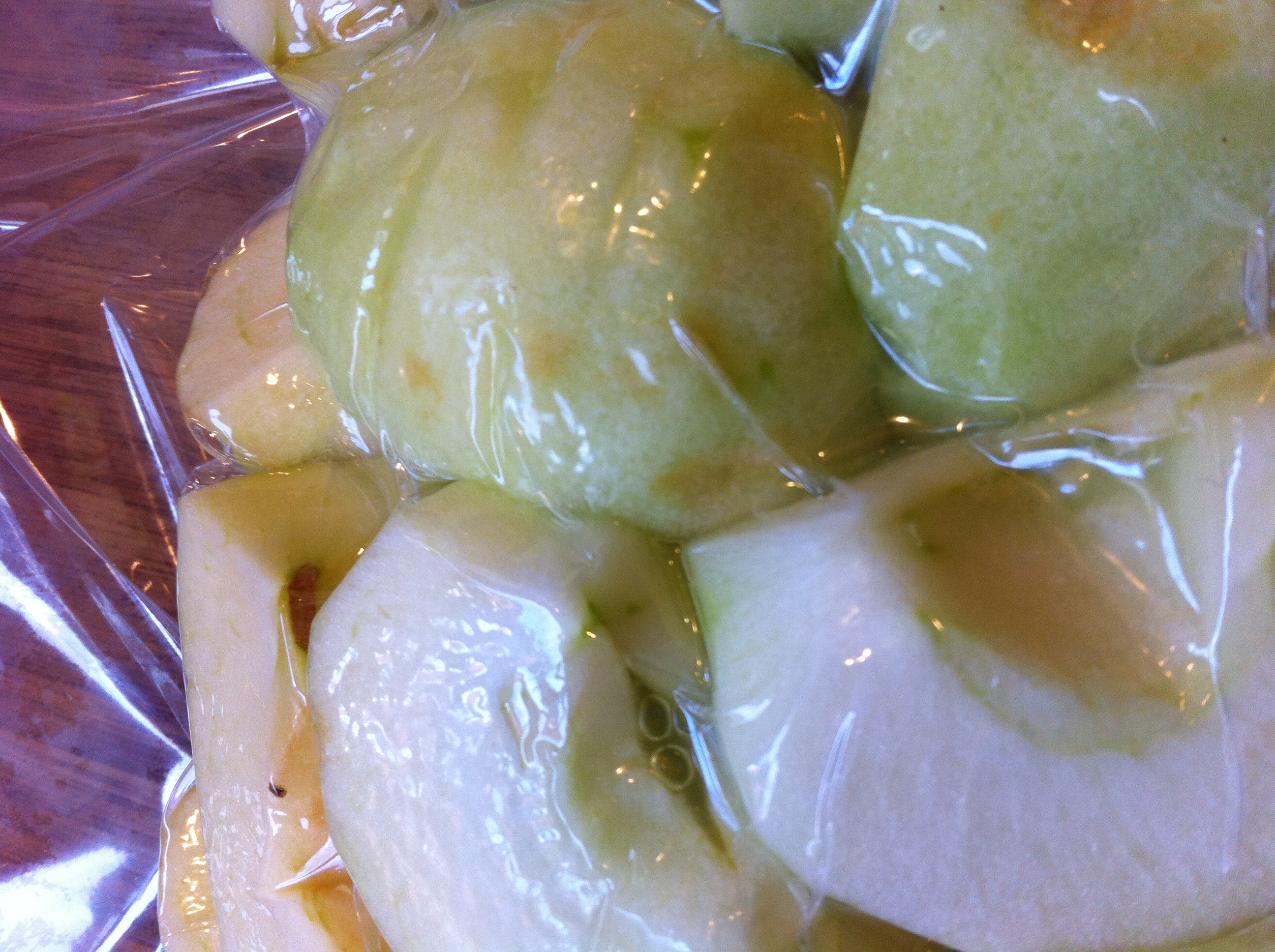
So the final recipe that called for sous vide was the apples.  These required no other ingredients.  Just slow cooked apples.  I like the simplicity.  I chose a mix of Red Delicious and Granny Smith apples.  Peeled and quartered, I sealed them up and put them in.

Sealed Apples

Apples Sous Vide

After they were done I blended them together and…wow.  Sous vide apple sauce.  So smooth, so creamy.  Just ridiculously good.

Smooth Apple Puree

This Tastes So Good. Whoa.

It’s funny how the texture improved with each progressive recipe.  I felt like Goldilocks – “Ahhh, this porridge is just right!” And now, because of the parametric recipe, I know how to apply it to other fruit and vegetables like pears and carrots as well.  I am loving this cookbook that isn’t published yet.  Awesome.

Apple Puree

Jethro

← Older posts
Newer posts →

Search

Categories

From the Twitterverse

Tweets by jcgastrophysics

Feed Yourself

  • RSS - Posts

Recent Posts

  • Ferran In America
  • That One Time We Applied For A Food Patent
  • Ideas In Food At Home: Coffee Onion Rings
  • BOOM: Sansaire Circulator Raises $823k On Kickstarter
  • Dining Northwest Style at The Willows Inn
  • Sansaire, The $199 Circulator: A Brief History
  • Modernist Cuisine At Home: Barbeque Rubs And Another Sauce
  • Modernist Cuisine At Home: More Barbeque Sauces
  • The Price Of Cooking Modernist Cuisine, Part IV: More Gadgets, Ingredients and Resources
  • Modernist Cuisine At Home: Compressed Melon Terrine
  • That One Time We Were Nominated For Best Culinary Science Blog
  • Gastrophysics Labs Closes Doors; Reopens As A “Kitchen”

From the Archives

  • March 2014
  • November 2013
  • September 2013
  • August 2013
  • July 2013
  • May 2013
  • April 2013
  • March 2013
  • February 2013
  • January 2013
  • December 2012
  • November 2012
  • October 2012
  • September 2012
  • August 2012
  • July 2012
  • June 2012
  • May 2012
  • April 2012
  • March 2012
  • February 2012
  • January 2012
  • December 2011
  • November 2011
  • October 2011
  • September 2011
  • August 2011
  • July 2011
  • June 2011
  • May 2011
  • April 2011
  • March 2011
  • February 2011
  • January 2011
  • December 2010
  • November 2010
  • October 2010
  • September 2010
  • August 2010

Blogroll

  • A Practical Guide to Sous Vide Cooking
  • Alinea At Home
  • Chef Rubber
  • Cooking Issues
  • eGullet
  • Eric Rivera's Cooking Blog
  • Ideas In Food
  • Khymos
  • L'epicerie
  • LeSanctuaire
  • Modernist Cuisine
  • Modernist Pantry
  • Seattle Food Geek
  • Studio Kitchen
  • The Alinea Project
  • Willequipped
  • Willpowder

  • ericriveracooks's avatar ericriveracooks
  • jethro's avatar jethro
  • sheimend's avatar sheimend

Blog at WordPress.com.

Privacy & Cookies: This site uses cookies. By continuing to use this website, you agree to their use.
To find out more, including how to control cookies, see here: Cookie Policy
  • Subscribe Subscribed
    • Jet City Gastrophysics
    • Join 161 other subscribers
    • Already have a WordPress.com account? Log in now.
    • Jet City Gastrophysics
    • Subscribe Subscribed
    • Sign up
    • Log in
    • Report this content
    • View site in Reader
    • Manage subscriptions
    • Collapse this bar
 

Loading Comments...